
This is Part 6—the finale of the Pyramid Series. We’ve spent five articles diagnosing the disease: the upside-down pyramid, the leader’s dilemma, the silo factory, the audit flywheel, and the human cost. Now it’s time for the cure.
This is the playbook. Not theory. Not frameworks. Not another diagnosis. Concrete steps that a technology leader can start executing on Monday morning to flip their pyramid right-side up—without burning the organization down in the process.
Let’s go.
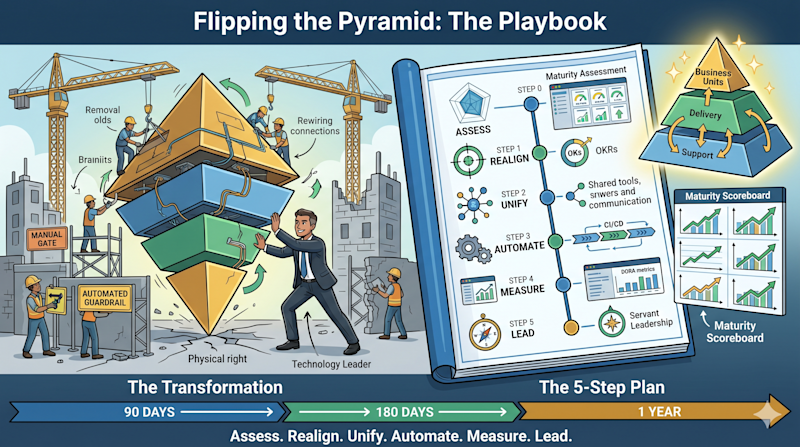
Step 0: Run the Maturity Assessment (Before You Touch Anything)
We’ve been building toward this throughout the series. Before you restructure teams, rewrite incentives, or automate a single gate, you need to know where you stand. Not where you think you stand. Not where last year’s consultant report said you’d be. Where you actually are, today, across every dimension that matters.
The Maturity Assessment is your diagnostic foundation. It spans five pillars:
Pillar 1: Organizational Structure & Leadership
Is the technology org structured to enable delivery or to control it?
Do support teams report to leaders who are measured on delivery outcomes?
Is there a single accountable leader for the end-to-end delivery pipeline?
Does leadership operate with a control mindset or an enable mindset?
Are support teams organized as silos or integrated into delivery streams?
Pillar 2: SDLC & Agile Maturity
Do delivery teams run true iterative sprints, or waterfall with Agile labels?
Is the definition of done shared across delivery and support teams?
Are retrospective findings actually implemented, or do they collect dust?
Is backlog refinement collaborative (product + engineering + support) or siloed?
Does the SDLC include automated quality gates or only manual checkpoints?
Pillar 3: DevOps & Automation
What is the deployment frequency? (Daily? Weekly? Monthly? Quarterly?)
What percentage of the deployment pipeline is automated end-to-end?
Is infrastructure provisioned through code (Terraform, Pulumi) or manual tickets?
Are security scans, compliance checks, and QA tests integrated into CI/CD?
Can a developer go from code commit to production without a single manual approval?
Pillar 4: Cross-Team Integration
Do support teams and delivery teams share a common work management ecosystem?
How many handoffs does a typical feature require across teams?
Do all teams plan on the same cadence?
Are cross-team dependencies visible before they become blockers?
Is there a single, prioritized view of all work—delivery and support?
Pillar 5: Human & Cultural Health
What is the maker time ratio for engineers? (Target: >60%)
What is the delivery friction score? (Handoffs, wait states, approval queues)
What is voluntary attrition for senior technical roles?
How prevalent is Shadow IT? (A proxy for process failure)
Do teams feel psychologically safe to challenge process and propose improvements?
Score each dimension on a simple scale—1 (ad hoc/broken) to 5 (optimized/automated). Visualize the results as a radar chart or heat map. The gaps will be immediately obvious—and they’ll tell you exactly where to start.
The maturity assessment isn’t a report card. It’s a roadmap. Low scores aren’t failures—they’re the highest-leverage opportunities for improvement.
Step 1: Realign Incentives (Days 1–30)
Nothing changes until the incentives change. This is the first move because everything else depends on it.
What to Do
Rewrite every support team leader’s OKRs to include at least one delivery outcome metric. Cyber’s objectives include deployment pipeline pass rate. QA’s include test automation coverage and release cycle time. PMO’s include time-to-value. EA’s include pattern adoption rate. Nobody’s success is measured solely by their internal output.
Establish a shared North Star metric: time from idea to production. Every team—delivery and support—is accountable for making this number go down. Display it publicly. Review it weekly.
Kill vanity metrics. Stop tracking tickets closed, meetings held, documents produced, and findings remediated as success indicators. These measure activity, not outcomes. Replace them with deployment frequency, lead time for changes, change failure rate, and mean time to recovery (the DORA metrics).
How to Make It Stick
Tie the new metrics to performance reviews, bonuses, and promotion criteria. If a support team leader can get a top performance rating while delivery velocity is declining, your incentives are still broken. The metrics need teeth.
If you change the org chart but not the incentives, you’ve rearranged the furniture. If you change the incentives, the org chart will follow.
Step 2: Unify the Foundation (Days 30–90)
Break the silos. This is the structural transformation that turns disconnected fiefdoms into an integrated foundation.
Shared Tooling
Mandate one work management ecosystem across all support and delivery teams. Jira, Azure DevOps, Linear—pick one and consolidate. Every team’s work is visible in one place.
Eliminate shadow systems. If Cyber has a GRC tool that creates tickets, those tickets flow into the shared backlog—not a separate queue.
Implement shared dashboards that show the complete picture: delivery work, support work, dependencies, and blockers—all in one view.
Shared Planning
Synchronize all teams to the delivery cadence. If delivery runs two-week sprints, support teams align their capacity planning to the same cycle.
Introduce cross-team planning sessions at the start of each sprint. Dependencies are identified and negotiated upfront, not discovered mid-sprint.
Create a unified prioritization framework. When Cyber, QA, PMO, and Infrastructure all claim their work is P1, there needs to be a clear, agreed-upon tiebreaker—owned by the technology leader.
Embedded Support
Move from centralized gate-keeping teams to embedded enabling teams, following the Team Topologies model:
Security engineers embedded in delivery squads, doing threat modeling and code review as part of the sprint—not after it.
QA automation engineers as part of the delivery team, writing automated tests alongside feature code—not running manual regression suites after the fact.
Architecture guidance available on demand, through lightweight consultations and reference patterns—not six-week review board queues.
Infrastructure as a platform team, providing self-service APIs and Terraform modules—not a ticket queue with a five-day SLA.
The goal isn’t to eliminate support teams. It’s to reposition them from centralized bottlenecks to distributed enablers. Same people. Same skills. Radically different impact.
Step 3: Automate the Gates (Days 60–150)
Every manual gate in your delivery pipeline is a potential bottleneck, a capacity drain, and a point of failure. Systematically replace them with automated guardrails.
The Automation Hit List
Security scanning: SAST, DAST, SCA, and secret detection running automatically in the CI/CD pipeline on every pull request. No manual security review for standard changes.
QA regression: Automated test suites running on every build. Manual QA only for exploratory testing and UX validation—not for regression.
Compliance checks: Policy-as-code using Open Policy Agent, AWS Config Rules, or equivalent. Compliance is validated continuously, not annually.
Infrastructure provisioning: Self-service through Terraform modules, Backstage catalogs, or internal platform APIs. No tickets. No manual approvals for pre-approved patterns.
Change management: Standard changes auto-approved through the pipeline. CAB review only for genuinely high-risk changes—and define “high-risk” narrowly.
Evidence collection: Automated audit evidence generation from pipeline telemetry, access logs, and configuration state. No manual screenshot binders.
The 80/20 Rule
You won’t automate everything on day one. Start with the gates that cause the most friction. The maturity assessment will tell you which ones those are. In most organizations, the top three bottlenecks (usually security review, infrastructure provisioning, and change advisory board) account for 80% of the delivery friction. Automate those first.
The best deployment pipeline is one where the developer never has to stop and wait. Every approval that can be automated should be automated. Every approval that can’t should have a clear SLA and a bypass for emergencies.
Step 4: Measure What Matters (Ongoing)
You can’t manage a transformation you can’t measure. Establish a measurement framework that tracks both delivery performance and organizational health.
The Leadership Dashboard
Every technology leader should have a single dashboard—reviewed weekly—that shows:
DORA Metrics: Deployment frequency, lead time for changes, change failure rate, mean time to recovery. These are the vital signs of your delivery pipeline.
Time-to-value: Average time from feature request to production deployment. This is the metric the business cares about most.
Delivery friction score: Number of handoffs, wait states, and manual approvals in the delivery pipeline. Track it quarterly. Watch it trend down.
Maker time ratio: Percentage of engineer time spent on productive work versus process overhead. Target: >60%.
Automation rate: Percentage of security, QA, compliance, and infrastructure tasks that are fully automated. Track by category.
Maturity assessment scores: Quarterly reassessment across all five pillars. Trend lines matter more than absolute scores.
Talent health: Voluntary attrition by role, time-to-productive for new hires, Shadow IT prevalence, retrospective action rate.
Making It Visible
Don’t hide these metrics in a quarterly report. Display them on a screen in the engineering area. Share them in all-hands meetings. Make them part of the weekly leadership standup. Transparency creates accountability—and it signals to the entire organization that this is what we care about now.
Step 5: Lead with Modern Organizational Theory (Always)
The structural changes above will fail if the leadership operating model doesn’t change with them. This is where the ideas from Part 2 become operational:
Team Topologies in Practice
Stream-aligned teams own the delivery end-to-end. They have everything they need to ship—engineering, QA, security, design—embedded or on demand.
Enabling teams (Cyber, QA, EA, SDLC Governance) exist to reduce the cognitive load on stream-aligned teams. Their success is measured by how fast the streams deliver, not by how many reviews they conduct.
Platform teams (Infrastructure, DevOps) provide self-service internal products—APIs, modules, templates—that stream-aligned teams consume without filing tickets.
Complicated-subsystem teams own deep technical domains (data platform, ML infrastructure) and expose clean interfaces that stream-aligned teams use without needing to understand the internals.
The Inverse Conway Maneuver
Design your team structure to produce the architecture you want. If you want loosely coupled microservices, organize autonomous teams around business domains. If you want a unified platform, create a platform team with a product mindset. Stop letting accidental org structure dictate accidental architecture.
Servant Leadership at Every Level
Every manager, from the CTO to the team lead, operates with one question: “What do my teams need from me to ship faster?” The answer is never “more process.” It’s usually “fewer obstacles, better tools, clearer priorities, and more trust.”
The technology leader’s job isn’t to control the organization. It’s to create the conditions where talented people can do their best work—and then get out of the way.
The Transformation Roadmap: 90 Days, 180 Days, 1 Year
Days 1–90: Foundation
Run the maturity assessment. Share results with all team leaders.
Rewrite support team OKRs to include delivery outcome metrics.
Mandate shared tooling. Begin migration to a single work management ecosystem.
Identify the top three automation targets (highest friction gates).
Establish the leadership dashboard with DORA metrics and delivery friction score.
Begin embedding security and QA engineers into delivery squads (pilot with one or two teams).
Days 90–180: Acceleration
Automate the top three friction gates.
Synchronize all teams to the delivery cadence. Launch cross-team sprint planning.
Implement continuous compliance monitoring for the highest-priority controls.
Expand the embedded support model to all delivery teams.
Run the maturity assessment again. Measure delta. Celebrate improvements. Escalate regressions.
Begin policy-as-code initiative for the most frequently audited controls.
Days 180–365: Maturity
Achieve >70% automation rate across security, QA, compliance, and infrastructure gates.
Eliminate manual change advisory board for standard changes.
Audit becomes a non-event: evidence generated automatically from pipeline telemetry.
Platform team provides self-service infrastructure. Provisioning time drops from days to minutes.
Maker time ratio for engineers exceeds 60%.
Run the maturity assessment quarterly. Track trend lines. Adjust priorities based on results.
Voluntary attrition for senior technical roles shows measurable improvement.
Making the Case to the Board
Technology leaders don’t flip pyramids in a vacuum. They need board support—and boards speak the language of risk and return, not deployment frequency and CI/CD pipelines.
Here’s how to translate the transformation into business language:
Cost of delay: “Every week a feature is stuck in the approval pipeline is a week of revenue we’re not capturing. Our current delivery friction adds an average of X weeks to every initiative. That’s $Y in deferred revenue per quarter.”
Talent economics: “We’re losing senior engineers at X% per year. Each departure costs $200–400K in recruiting, ramp-up, and lost institutional knowledge. Our maturity assessment shows delivery friction as the #1 driver.”
Audit efficiency: “We currently spend X FTE-months per year on audit preparation. By automating controls and continuous evidence collection, we can reduce this to Y—freeing Z engineers to work on revenue-generating features.”
Risk reduction: “Paradoxically, our manual controls are less effective than automated ones. Our change failure rate is X% with manual CAB review. Industry benchmarks for automated pipelines with built-in testing show Y%. More automation means less risk, not more.”
Competitive velocity: “Our deployment frequency is X per month. Industry leaders in our space deploy Y times per day. That’s not a vanity metric—it’s the difference between responding to market changes in hours versus months.”
The board doesn’t need to understand Team Topologies or policy-as-code. They need to understand that the current structure is costing the company money, talent, and competitive position—and that you have a data-driven plan to fix it.
The Bottom Line: Flip the Pyramid or Get Crushed by It
Let’s bring it full circle.
In Part 1, we showed you the two pyramids. The right-side-up one—where support teams enable delivery, and the whole structure is oriented toward business value. And the upside-down one—where governance, process, and control crush the business under their weight.
In Parts 2 through 5, we showed you why pyramids get inverted: leaders who default to control, teams that fragment into silos, audits that become the product, and a human cost that silently bleeds the organization of its best people.
And now, in Part 6, we’ve given you the how: run the maturity assessment, realign incentives, unify the foundation, automate the gates, measure what matters, and lead with modern organizational theory.
None of this is easy. Transformation never is. There will be resistance from teams that have built empires in the current structure. There will be a messy middle where the old model is dying but the new model isn’t fully born. There will be moments where the safe move is to stop and revert.
Don’t.
The organizations that thrive in the next decade will be the ones that figured out how to deliver business value at speed—safely, sustainably, and with their best people energized instead of exhausted. The technology leaders who build those organizations will be the ones who had the courage to flip the pyramid, the discipline to measure the transformation, and the patience to see it through.
Your pyramid is either right-side up or upside down. There is no middle ground. And every day you wait to flip it, the weight gets heavier.
The best time to flip your pyramid was five years ago. The second best time is Monday morning. You have the playbook. You have the maturity assessment. You have the data. The only question left is: do you have the courage?
This is the final installment of the Pyramid Series. Read the full series: Part 1 • Part 2 • Part 3 • Part 4 • Part 5
Back to Blog