
This is Part 5 of the Pyramid Series. In Part 4, we broke down the audit flywheel—the self-reinforcing cycle that eats your roadmap. Now let’s talk about the damage that doesn’t show up in any dashboard: the human cost.
Process dysfunction is abstract. Org charts are theoretical. But the engineer who just gave two weeks’ notice? The product manager who stopped pushing back and started quietly updating her LinkedIn? The senior architect who used to challenge bad decisions but now just shrugs and says, “Whatever gets through the review board”?
That’s not abstract. That’s your best people telling you—with their feet—that the pyramid is upside down.
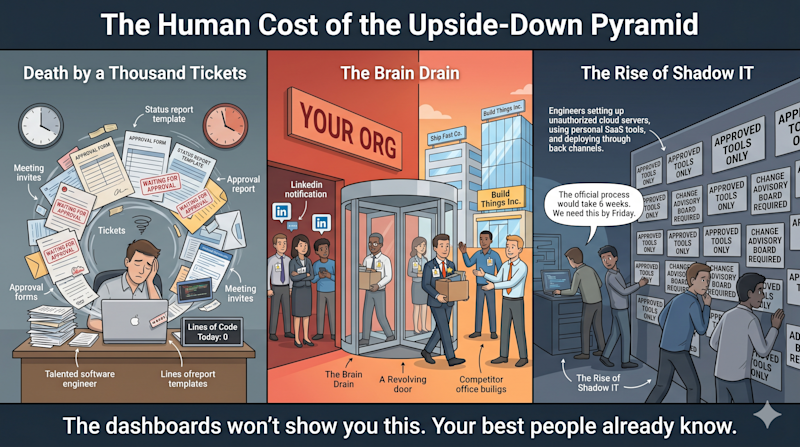
Death by a Thousand Tickets
Let’s start with what a typical day looks like for a talented engineer inside an upside-down pyramid.
They arrive (or log on) ready to build. They have a clear sprint goal. They know what the business needs. They’re motivated. And then:
They need a new AWS IAM role. That’s a ticket to Infrastructure. Estimated wait: 5 business days.
The IAM role needs a security review. That’s a separate ticket to Cyber. Estimated wait: 3-7 business days. But Cyber won’t review it until Infrastructure provisions it. So the waits are sequential, not parallel.
Their pull request is ready, but it can’t merge until QA signs off on the test plan. QA is running last sprint’s regression suite and won’t get to this PR until Thursday.
The feature requires a minor architecture change. Enterprise Architecture needs to review it. The next EA review board meets in two weeks.
The PMO needs an updated status report by end of day. It’s the third status report this week, each for a different audience, each in a different format.
An audit remediation task just landed in their sprint. It wasn’t planned. It’s not negotiable. It displaces the feature work the business is waiting for.
By 4 PM, this engineer has written zero lines of production code. They’ve filed tickets, waited for approvals, attended two status meetings, reformatted a status report, and started an audit task they didn’t ask for. Tomorrow will be the same.
The upside-down pyramid doesn’t just slow down delivery. It turns skilled engineers into full-time ticket operators and part-time meeting attendees who occasionally get to write code.
This is death by a thousand tickets. No single request is unreasonable. No single gate is absurd in isolation. But the cumulative weight of a hundred small frictions turns a ten-hour coding week into a two-hour coding week—and the best engineers know exactly how many hours they’re losing.
The Brain Drain: Why Your Best People Leave First
Here’s a pattern every technology leader should recognize but few want to admit: the best people leave first.
Not the average performers. Not the ones who are comfortable filling out forms and attending governance meetings. The best ones. The senior engineer who could redesign your entire platform. The staff architect who sees problems nobody else sees. The product manager who actually understands the customer. The delivery lead who knows how to ship.
They leave because they have options. The market for top technology talent is brutally competitive, and the organizations that have figured out modern delivery are actively recruiting your best people with a simple pitch: “Come work somewhere that lets you build things.”
What makes this especially insidious is the feedback loop it creates:
Top talent leaves. The people with the deepest expertise, the strongest opinions, and the most ability to challenge dysfunction walk out the door.
Institutional knowledge walks with them. Nobody else knows why that architecture decision was made, how that integration actually works, or where the real technical debt is buried.
Remaining teams slow down further. Less expertise means more mistakes, longer ramp-up times for replacements, and increased dependency on the governance structures the departing talent was working around.
The org doubles down on process. “We need more controls because we can’t rely on individual expertise anymore.” More gates. More reviews. More overhead. The pyramid gets heavier.
More top talent leaves. The cycle accelerates.
You don’t lose your best engineers to competitors. You lose them to frustration. The competitor just happens to be standing there when they’ve finally had enough.
And here’s the part that should keep technology leaders up at night: by the time someone resigns, the decision was made months ago. The resignation is just the paperwork. The actual departure—the moment they mentally checked out, stopped pushing back, stopped caring about the architecture, stopped mentoring juniors—happened long before. The exit interview won’t tell you this. But a maturity assessment that measures team engagement, process friction, and delivery satisfaction will.
The Rise of Shadow IT: A Symptom, Not a Crime
When the official process is too slow, talented people don’t just leave. Some of them stay—and go rogue.
Shadow IT is the term organizations use to describe unauthorized technology use: teams spinning up AWS accounts on corporate credit cards, using unapproved SaaS tools, deploying to production through back channels that bypass the change management process. Most governance teams treat Shadow IT as a security problem to be stamped out. They’re wrong.
Shadow IT is a symptom of a delivery system that has failed its users. Every instance of Shadow IT is a team saying, “The official process is so slow and so painful that we’d rather risk getting caught than wait for it to work.”
Think about what that means. These teams are so frustrated by the governance overhead that they’re willing to accept the security risk, the compliance risk, and the career risk of going around it. That’s not a discipline problem. That’s a process indictment.
If infrastructure provisioning takes two weeks, teams will spin up their own cloud resources.
If the approved CI/CD pipeline has a three-day approval queue, teams will deploy manually or build their own pipeline.
If the QA process adds a week to every release, teams will skip it and ship directly.
If the approved collaboration tools are clunky and locked down, teams will use Slack, Notion, or whatever SaaS tool they can sign up for with a credit card.
And here’s the ultimate irony: Shadow IT creates exactly the risks that the governance layer was supposed to prevent. Unmonitored cloud accounts. Unscanned code in production. Data in unsanctioned tools. The more the governance layer tightens control, the more Shadow IT proliferates, and the more risk the organization actually faces.
You can’t stamp out Shadow IT by adding more rules. You stamp it out by making the official path faster than the unofficial one.
The Culture Tax: What Process Overhead Does to Team Morale
Beyond the tangible costs—slower delivery, talent attrition, Shadow IT—the upside-down pyramid exacts a subtler but equally devastating toll: it kills the culture.
Culture isn’t mission statements on the wall or values listed on the careers page. Culture is how work actually gets done. And in an upside-down pyramid, the culture becomes:
Learned helplessness. “There’s no point pushing back. The review board will reject it anyway.” Engineers stop advocating for better solutions. They learn to submit the form, wait for the approval, and ship whatever gets through—regardless of whether it’s the right solution.
CYA over craftsmanship. Every decision is made with one eye on the audit trail. “Did we document the decision? Did three people sign off? Is there a ticket?” Quality of thought is replaced by quality of paperwork.
Risk avoidance over innovation. Why propose a new approach when it will trigger a six-week EA review? Why suggest a better tool when the procurement process takes four months? Teams default to the safe, approved, mediocre option because the cost of trying something better is too high.
Blame culture. When something goes wrong, the first question isn’t “How do we fix it?” It’s “Who didn’t follow the process?” Blameless retrospectives are impossible in an organization built on gates and approvals, because every gate implies someone is accountable for letting something through.
Quiet quitting. Not everyone who checks out actually leaves. Some stay, collect their paycheck, and disengage. They attend the meetings, file the tickets, and produce the minimum required output. They’ve given up on the organization changing, but they haven’t found their next job yet. These are your most expensive employees: full salary, zero discretionary effort.
The upside-down pyramid doesn’t just lose the people who leave. It hollows out the people who stay.
The Technology Leader’s Mirror
If you’re a CTO, CIO, or VP of Engineering reading this and thinking, “This sounds like my org,” here’s the hard truth: you built this.
Not intentionally. Not maliciously. But every gate that slows delivery, every silo that fragments coordination, every audit flywheel that eats the roadmap—those exist because you created the conditions for them. You hired the leaders who built the silos. You approved the processes that became the gates. You tolerated the metrics that reward activity over outcomes.
The good news: if you built it, you can change it. But you have to start by looking in the mirror and asking some uncomfortable questions:
When was the last time I asked an engineer what their biggest frustration is—and actually acted on the answer?
Do I know how many hours per week my delivery teams actually spend writing code versus filing tickets and attending governance meetings?
Can I name the top three reasons my best people left in the last year? Not the exit interview answers—the real reasons?
Do I measure team satisfaction and delivery friction, or only output metrics like velocity and uptime?
When was the last time I eliminated a process, a meeting, or an approval gate—instead of adding one?
If you can’t answer these questions confidently, you’re leading blind. And that’s where the maturity assessment becomes essential—not just as an organizational diagnostic, but as a human diagnostic.
The Maturity Assessment: Measuring What Dashboards Miss
Traditional maturity assessments measure process capabilities: SDLC maturity, DevOps adoption, Agile practices. These matter. But they miss the human dimension that determines whether any transformation will actually stick.
A truly comprehensive maturity assessment must include dimensions that capture the people side:
Delivery friction score: How many handoffs, approvals, and wait states does a typical feature encounter between idea and production? Measure it. Track it quarterly. This single metric correlates more strongly with talent retention than any engagement survey.
Maker time ratio: What percentage of an engineer’s week is spent on productive work versus process overhead (meetings, status reports, ticket management, audit tasks)? If it’s below 60%, your pyramid is upside down.
Time-to-productive for new hires: How long does it take a new engineer to ship their first feature? In a right-side-up pyramid, it’s days. In an upside-down one, it’s weeks or months—because they’re learning the governance labyrinth, not the codebase.
Shadow IT prevalence: How many unauthorized tools, accounts, and workarounds exist in the organization? Don’t punish the teams using them—measure them as a proxy for process failure.
Voluntary attrition by role: Are you losing senior engineers and tech leads at a higher rate than junior developers? That’s the brain drain signal. The people with the most options are exercising them.
Retrospective action rate: When teams identify process improvements in retrospectives, what percentage actually get implemented? If it’s below 30%, people have learned that feedback is theater—and they’ve stopped giving honest input.
Cross-team collaboration frequency: How often do support teams and delivery teams interact outside of formal gate reviews? Low frequency means silos. High frequency means the foundation is actually serving the builders.
These dimensions won’t show up in your Jira velocity charts or your PMO’s project status reports. But they’re the leading indicators that predict whether your organization can attract, retain, and energize the people it needs to deliver. By the time the lagging indicators appear—missed deadlines, rising attrition, declining quality—the damage is already done.
A maturity assessment that only measures process is measuring the machine. One that also measures the human experience is measuring whether anyone will still be around to operate it.
What the Best Organizations Get Right
Organizations that don’t hemorrhage talent in the upside-down pyramid pattern share a few common traits:
They protect maker time. Meeting-free blocks. Async-first communication. Status updates pulled from tools, not demanded in live meetings. Engineers get to engineer.
They invest in developer experience (DevEx). Fast CI/CD pipelines. Self-service infrastructure. One-click environments. Automated testing. The internal tooling is treated as a product, not an afterthought.
They treat process as a product. Processes have owners, users, and feedback loops. If a process isn’t serving its users, it gets iterated on or killed—just like a product feature that nobody uses.
They run blameless retrospectives. When something goes wrong, the response is systemic improvement, not individual punishment. This creates psychological safety—the single strongest predictor of team performance.
They measure what they value. Delivery friction, maker time, developer satisfaction—these are on the leadership dashboard alongside revenue and uptime. What gets measured gets managed.
They listen to exits. Not the sanitized exit interview. Real conversations with departing employees, conducted by someone the employee trusts, with findings reported to the CTO—not HR.
What’s Next
We’ve spent four articles diagnosing the disease: the upside-down pyramid, the leader’s dilemma, the silo factory, the audit flywheel, and now the human cost. It’s time for the cure.
In Part 6: Flipping the Pyramid — A Technology Leader’s Playbook, we’ll lay out the complete, practical guide for technology leaders who are ready to transform their organization. Step-by-step: how to realign incentives, unify the foundation, automate the gates, measure what matters, and lead with modern organizational theory. Including the full maturity assessment framework that ties the entire series together.
This is Part 5 of a 6-part series. Read Part 1, Part 2, Part 3, and Part 4 if you haven’t already.
Back to Blog