
This is Part 4 of the Pyramid Series. In Part 3, we dissected how technology support teams fragment into disconnected silos. Now let’s talk about the engine that keeps making it worse: the audit flywheel—the self-reinforcing cycle where compliance stops being a guardrail and becomes the product.
If your technology roadmap has ever been hijacked by “audit remediation,” if your best engineers have ever been pulled off feature work to collect evidence for an assessor, or if you’ve ever watched a team spend six months implementing a control that a script could handle in an afternoon—this one’s for you.
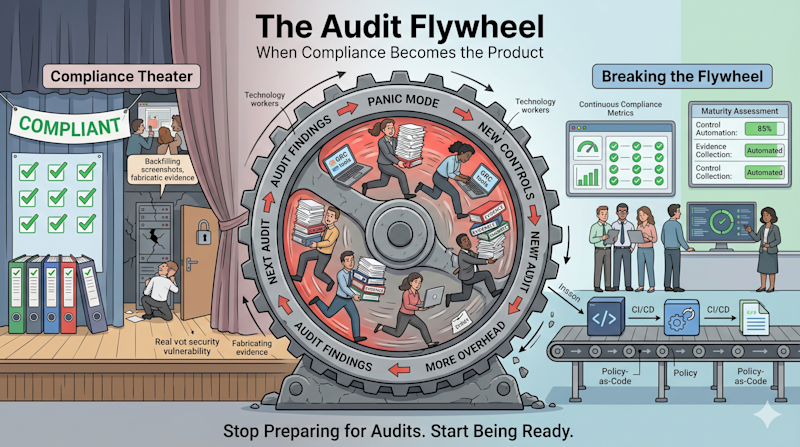
The Flywheel Nobody Asked For
Every organization needs audits. SOC 2, ISO 27001, PCI-DSS, HIPAA, FedRAMP—depending on your industry, you’re dealing with one or several of these frameworks. And the intent behind them is sound: verify that controls exist, that they work, and that the organization is managing risk responsibly.
The problem isn’t the audit itself. The problem is how most technology organizations respond to it.
Here’s the cycle:
The audit produces findings. Gaps in access controls, missing documentation, inconsistent logging, a policy that hasn’t been updated since 2019. The assessor flags them. Management gets nervous.
Panic mode activates. Cyber, the PMO, and SDLC Governance drop everything to remediate. Engineers get pulled off delivery work to help collect evidence, implement patches, and document controls. The technology roadmap takes a back seat to the audit response.
New controls are introduced. Policies are hastily rewritten. New procedures are created. Manual checklists get longer. QA adds new test cases. A new approval gate appears in the deployment pipeline. Each finding generates a new control—and each control generates new overhead.
The organization absorbs the overhead. Support teams are now spending a significant chunk of their capacity maintaining, documenting, and evidencing the new controls. Delivery slows further.
The next audit arrives. The assessor reviews the new controls—and finds gaps in them, too. Because the controls were rushed, they’re often incomplete, inconsistently applied, or poorly documented. New findings are generated.
Repeat. The flywheel spins again, heavier each time.
The audit flywheel doesn’t make you more secure. It makes you more busy. There’s a difference.
Compliance Theater: Looking Good on Paper While the Real Risks Go Unaddressed
Here’s the cruelest irony of the audit flywheel: the more time and energy your organization pours into reactive audit response, the less secure you actually become.
How? Because reactive compliance produces compliance theater—the appearance of control without the substance:
Policies that exist but aren’t followed. The 47-page access control policy was written to satisfy an auditor, not to guide behavior. Nobody on the delivery team has read it. Nobody on the security team enforces it consistently. But it’s in the evidence binder, so the finding is “closed.”
Manual controls that get skipped under pressure. The change advisory board is supposed to review every production deployment. In practice, when there’s a P1 incident at 2 AM, the CAB is bypassed and nobody goes back to document the exception. The control exists on paper; it fails in reality.
Evidence fabricated at the last minute. Two weeks before the audit, teams scramble to backfill screenshots, create retroactive approval records, and generate reports that “prove” controls were operating all year. Everyone knows it’s theater. Nobody says it out loud.
Security resources consumed by documentation, not defense. Your Cyber team is spending 60% of its time preparing audit evidence packages and updating GRC tools. That’s 60% of their capacity that isn’t going toward threat detection, vulnerability management, or actually making the organization more secure.
Meanwhile, the real risks—the unpatched critical vulnerability in a legacy system, the overly permissive IAM role that’s been there for three years, the production database that’s accessible from a dev VPN—go unaddressed because nobody has time to work on them. Everyone’s too busy preparing for the audit.
When your Cyber team spends more time documenting controls than implementing them, you haven’t achieved compliance. You’ve achieved paperwork.
The Capacity Trap: How Audits Eat Your Roadmap
Let’s talk about what the audit flywheel actually costs in terms of delivery capacity.
In a typical enterprise, audit-related work consumes a staggering amount of technology capacity that should be going toward business value:
Cyber: 40-60% of team capacity spent on audit prep, evidence collection, finding remediation, and GRC tool maintenance.
PMO: Entire workstreams created just to track audit remediation projects. Status meetings multiply. Reporting overhead doubles.
QA: New manual test cases added for every audit finding, even when automated tests already cover the same ground. Regression cycles grow longer.
Infrastructure: Change freezes imposed before audit windows. Configuration changes deferred. Capacity upgrades delayed because the change process is locked down.
Engineering: Developers pulled off feature work to help remediate findings, implement new controls, collect evidence, and attend audit prep meetings. Sprint velocity drops.
SDLC Governance: New process artifacts mandated for every control gap. Checklists grow. Ceremony increases. The overhead compounds sprint over sprint.
Add it up and the picture is grim: in many organizations, 20-40% of total technology capacity is consumed by audit-related work that produces no direct business value. That’s not a rounding error. That’s a quarter to nearly half of your technology investment going toward maintaining the audit flywheel instead of building products.
And here’s the part that should make every business leader furious: this capacity drain is invisible in most organizations. It doesn’t show up as a line item in the technology budget. It doesn’t appear on the CTO’s quarterly review. It’s hidden inside team utilization numbers, buried in “support activities,” and rationalized as “the cost of doing business.”
“Sorry, we can’t start that feature—Cyber needs the delivery team for SOC 2 remediation.” If you’ve heard this more than once, your flywheel is spinning.
The Technology Leader’s Blind Spot
Why do smart technology leaders let the audit flywheel consume their organizations? Because of the incentive trap we explored in Part 2: the asymmetric scorecard.
Failing an audit is a career-threatening event. Missing a feature deadline is a conversation. So the rational technology leader over-invests in audit response and under-invests in delivery velocity—even though the business impact of chronic slow delivery is far greater than the business impact of a single audit finding.
The blind spot is the assumption that more controls equals more security, and more audit prep equals better compliance. Neither is true. A hundred manual controls are less effective than ten automated ones. A thousand pages of policy documentation are less valuable than a single CI/CD pipeline with security scanning built in.
The best technology leaders understand a counterintuitive truth: the fastest path to audit readiness is investing in delivery excellence, not in audit preparation. Organizations that have automated their controls, baked compliance into their pipelines, and eliminated manual evidence collection don’t prepare for audits. They’re always ready. The audit becomes a non-event—a validation of how they already work, not a fire drill that hijacks the roadmap.
Breaking the Flywheel: From Reactive to Proactive
Breaking the audit flywheel requires a fundamental shift from reactive compliance to proactive, continuous compliance. Here’s what that looks like:
1. Policy-as-Code
Stop writing 47-page Word documents that nobody reads. Encode your policies as automated checks that run in your CI/CD pipeline. Access control policies become IAM rules enforced by Terraform. Security configurations become Open Policy Agent (OPA) rules. Compliance requirements become automated test suites. The policy is the enforcement—no gap between intent and implementation.
2. Continuous Compliance Monitoring
Instead of scrambling to collect evidence before an audit, instrument your systems to produce evidence continuously. Every deployment, every access change, every configuration modification is automatically logged, time-stamped, and tied to the control it supports. When the auditor asks for evidence, you don’t prepare a binder—you give them a dashboard.
3. Automated Control Testing
Don’t wait for an auditor to tell you your controls aren’t working. Test them automatically, continuously, the same way you test your code. Run automated control assertions daily. If a control drifts out of compliance, the system catches it immediately—not twelve months later during the annual assessment.
4. Shift Audit Prep Left
Just as modern engineering shifts testing left (earlier in the development process), shift audit preparation left. Build compliance requirements into user stories. Include control validation in your definition of done. Make compliance a continuous output of normal delivery work, not a separate, parallel workstream that competes for the same resources.
5. Consolidate the GRC Ecosystem
If your Cyber team uses one GRC tool, your PMO tracks remediation in another, and your SDLC Governance team has a third system for process compliance—consolidate. One integrated platform for risk, compliance, and control management. Shared visibility. Shared workflows. No more re-keying the same finding into four different systems.
The Maturity Assessment: Measuring the Flywheel’s Grip
How do you know how badly the audit flywheel has gripped your organization? The Maturity Assessment gives you the diagnostic. Here are the dimensions that reveal the flywheel’s hold:
Audit capacity impact: What percentage of technology team capacity is consumed by audit-related work? Track this quarterly. If it’s above 15%, the flywheel is winning.
Control automation rate: What percentage of your compliance controls are automated versus manual? Manual controls are flywheel fuel. Every manual control you automate breaks one link in the chain.
Evidence collection time: How long does it take to produce an evidence package for an auditor? If it’s more than a few hours per control, you’re doing it reactively.
Finding recurrence rate: What percentage of audit findings are repeat findings from previous audits? A high recurrence rate means your remediation is superficial—you’re treating symptoms, not causes.
Roadmap displacement: How many business features were deferred or deprioritized due to audit-related work in the last four quarters? This is the number that should terrify business leadership.
Time between compliance checks: Is compliance validated continuously, monthly, quarterly, or only during the annual audit? The longer the gap, the heavier the flywheel spins when audit season arrives.
Run this assessment alongside the silo assessment from Part 3. The two are deeply connected: siloed teams produce fragmented, manual controls that feed the audit flywheel. Breaking the silos and breaking the flywheel are two sides of the same transformation.
The maturity assessment doesn’t just tell you where you are—it tells you how much the flywheel is costing you. And once you can see the cost, you can build the case to break it.
What the Best Organizations Do Differently
Organizations that have broken the audit flywheel share a few common traits:
They treat compliance as an engineering problem, not a documentation problem. Controls are code. Evidence is telemetry. Audit readiness is a CI/CD pipeline feature.
They invest in automation upfront, even when it’s harder than writing a policy. Automating a control takes more effort initially than writing a manual procedure. But it pays back every single day thereafter.
They make audit readiness a leadership OKR. The CTO owns the metric. Time-to-evidence, control automation rate, and finding recurrence rate are on the quarterly review alongside deployment frequency and uptime.
They partner with their auditors. The best organizations don’t treat auditors as adversaries. They invite them in early, show them the automated controls, and collaborate on scope. Auditors want to see working systems, not binders full of screenshots.
They refuse to let audit remediation hijack the roadmap. Remediation work is sized, prioritized, and scheduled alongside feature work—not dropped on the delivery team as an unplanned fire drill.
What’s Next
The silos and the audit flywheel create organizational dysfunction. But the worst damage isn’t to processes or timelines—it’s to people.
In Part 5: The Human Cost, we’ll explore what happens to the engineers, product managers, and delivery leads who live inside the upside-down pyramid every day. Why your best people leave. Why Shadow IT thrives. Why culture eats process for breakfast—and how a maturity assessment reveals the human impact that spreadsheets and dashboards miss.
This is Part 4 of a 6-part series. Read Part 1, Part 2, and Part 3 if you haven’t already.
Back to Blog