
Every organization has the same three layers: the people who drive revenue, the people who build software, and the people who operate, support, & secure the technology. Simple enough, right?
But how you stack those layers determines whether your company ships products—or ships excuses.
Welcome to the Tale of Two Pyramids.
The Right-Side-Up Pyramid: Where Gravity Works For You
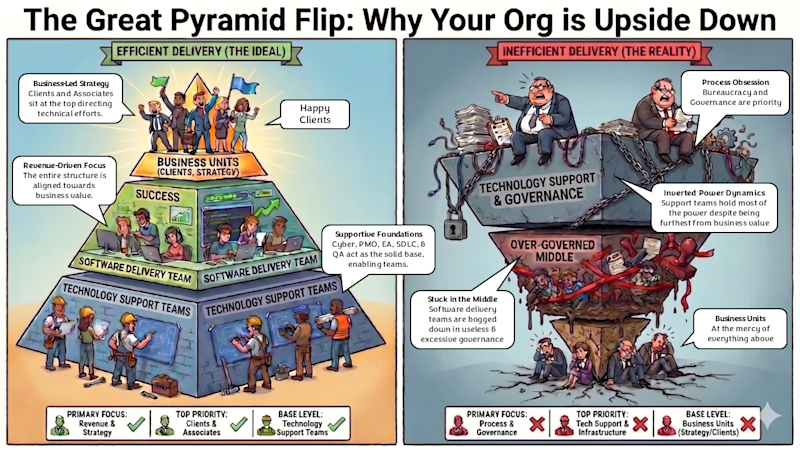
In a healthy organization, the pyramid looks exactly the way the ancient Egyptians intended: pointy end up, wide base down.
At the top: Business Units. These are your revenue drivers, your client-facing strategists, the people who actually know what customers want and are accountable for the P&L. They set the direction. They define what "value" means. They're the reason the company exists.
In the middle: Software Delivery Teams. Product managers, engineers, designers—the builders. Their entire job is to translate business strategy into working software. They push the business units higher by shipping features that customers actually pay for.
At the base: Technology Support Teams. Cyber Security, SDLC Governance, the PMO, Infrastructure, DevOps, Enterprise Architecture, QA, and Reporting. The unsung heroes who build the automation, guardrails, CI/CD pipelines, and monitoring that let the delivery teams move fast without breaking things. The PMO keeps projects on track, Enterprise Architecture ensures systems fit together, SDLC Governance defines the playbook, and Reporting makes progress visible. They are the foundation—solid, reliable, and in service of the layers above them.
In this model, gravity is your friend. The weight of the foundation supports everything above it. Automated testing catches bugs before they ship. Infrastructure-as-code makes deployments boring (the good kind of boring). Security scanning runs in the pipeline, not in a three-week review board. The PMO streamlines delivery cadence instead of drowning teams in status reports. Enterprise Architecture provides reference patterns, not bottleneck approvals. The whole structure is oriented toward one thing: delivering business value as fast as safely possible.
The Upside-Down Pyramid: Where Gravity Crushes Your Business
Now flip that pyramid over. Go ahead, picture it. A massive stone structure balancing precariously on its tiny little point.
That point? Those are your Business Units—crushed at the bottom, gasping for air under the enormous weight of everything above them.
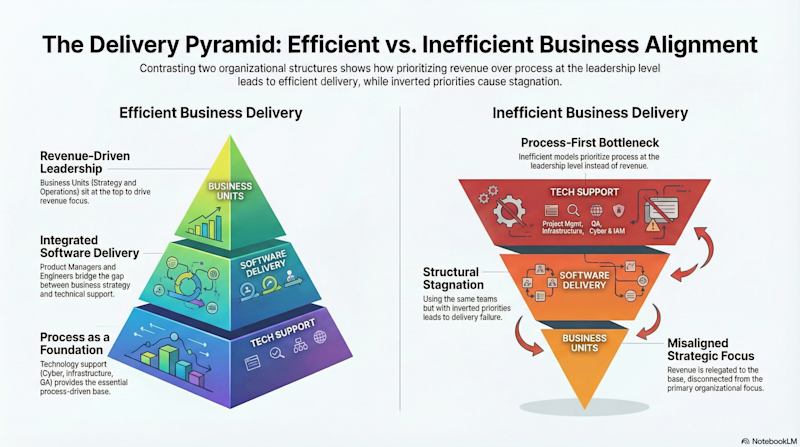
Technology Support and Governance sit at the top, occupying the widest, heaviest layer. The PMO dictates timelines and demands weekly status decks. Enterprise Architecture runs review boards that can stall projects for months. SDLC Governance mandates process ceremonies that no one finds valuable. QA insists on manual regression cycles that take weeks even when automated tests already cover the same ground. Reporting teams require data in seventeen different formats. They control the change advisory committees. They have veto power over everything—and accountability for nothing.
Software Delivery is squeezed in the middle, trying to build products while simultaneously navigating a labyrinth of approval workflows, mandatory architecture reviews, PMO status meetings, SDLC governance checklists, QA sign-off gates, 47-page security questionnaires, and change requests that require three signatures from people who haven’t written code since Java was the hot new language.
And at the very bottom? The Business. The people who actually talk to customers, close deals, and generate revenue are left waiting. Waiting for features. Waiting for fixes. Waiting for someone on the governance team to come back from PTO so they can approve a DNS change.
In the upside-down pyramid, the people with the least accountability for revenue hold the most power. And they'll tell you it's for your own good.
The Classic Hide-Behind: "It's for Security"
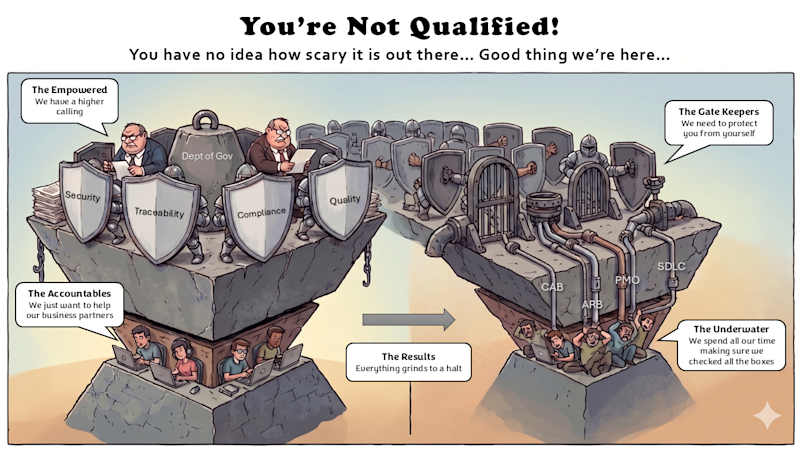
Here’s the part that really stings. The upside-down pyramid doesn’t feel broken to the people at the top of it. It feels responsible. It feels safe. The PMO calls it “project rigor.” Enterprise Architecture calls it “standards alignment.” SDLC Governance calls it “process maturity.” Every bureaucratic chokepoint has a perfectly reasonable justification:
“We can’t let teams deploy without CAB approval—what about security?”
“Every architecture change needs an EA review board—what about quality?”
“QA hasn’t signed off on the full regression suite yet—what about testing?”
“We need a 90-day change freeze before the audit—what about compliance?”
“The PMO needs a full project plan before we can start—what about governance?”
“We need updated SDLC artifacts and Reporting dashboards—what about traceability?”
Security, quality, testing, compliance, governance, and traceability are real concerns. Nobody is arguing otherwise. But in the upside-down pyramid, they’ve been weaponized. They’ve become shields that protect the governance layer—the PMO, Enterprise Architecture, QA, SDLC Governance, and Reporting teams—from accountability while strangling the delivery layer’s ability to ship.
It's the tail wagging the dog. The brakes are driving the car. The safety net has become a straightjacket.
The Audit Flywheel: How the Pyramid Gets Heavier
Here’s the part nobody talks about: the upside-down pyramid isn’t static. It’s accelerating.
Every audit cycle feeds the beast. A new finding drops—maybe it’s a gap in access controls, maybe it’s a logging deficiency, maybe it’s a policy that hasn’t been updated since 2019. Doesn’t matter. The response is always the same: the Cyber team scrambles to remediate. The PMO spins up a new workstream to track it. SDLC Governance drafts a new policy. The audit team documents a new control. And suddenly, technology initiatives have consumed the roadmap—not because the business asked for them, but because the latest audit demanded them.
This is the audit flywheel, and once it starts spinning, it’s almost impossible to stop:
Audit produces findings. Cyber, QA, infrastructure, and governance teams drop everything to respond.
New controls are introduced. Policies are rewritten. Procedures are updated. QA adds new manual test cases. Checklists get longer.
Support teams lose capacity. The people who should be building automation and enabling delivery are now buried in remediation work, evidence collection, regression testing, and control documentation.
Next audit finds new gaps. Because the controls were rushed and reactive, they’re often incomplete or poorly implemented—which generates even more findings.
Repeat. Forever. The cycle never ends. Each audit makes the governance layer heavier, and the pyramid tilts further upside down.
The result? Bloated Cyber, QA, PMO, Audit, and governance teams that are completely reactive. They spend all their time responding to the last audit instead of partnering with software delivery teams to build controls that are automated, sustainable, and actually effective. QA is running the same manual regression scripts they wrote five years ago instead of investing in automated test suites. They’re not bad people—they’re trapped in a bad system.
When your technology organization spends more time preparing for audits than building products, you’re not managing risk—you’re managing theater.
And here’s the cruelest irony: all that reactive governance work doesn’t actually make you more secure or compliant. Rushed policies collect dust. Manual controls get skipped under deadline pressure. Evidence is fabricated at the last minute. The org looks compliant on paper while the real risks—the ones that actually lead to breaches and outages—go unaddressed because nobody has time to work on them.
Meanwhile, the business units at the bottom of the pyramid watch their roadmap get hijacked quarter after quarter. “Sorry, we can’t start that feature—Cyber needs the delivery team to help with the SOC 2 remediation.” “The PMO redirected our engineers to the audit response workstream.” The business didn’t ask for any of this. But they’re paying for all of it.
The Silo Problem: A Foundation That Can’t Talk to Itself
Now layer on one more dysfunction, and the picture gets truly grim: all of these technology support teams operate in silos.
Cyber has its own ticketing system, its own prioritization framework, and its own definition of “done.” The PMO tracks work in a completely different tool with a completely different methodology. Enterprise Architecture maintains a backlog that nobody outside EA has ever seen. QA has its own test management platform, its own defect tracking workflow, and its own release criteria that may or may not match what the delivery team considers “shippable.” SDLC Governance has its own set of ceremonies. Infrastructure runs its own change management process. Reporting pulls data from wherever it can and reconciles nothing.
Each team has its own leadership, its own incentives, and its own success metrics—none of which are aligned with each other, let alone with the software delivery teams they’re supposed to support. Cyber is measured on findings closed. The PMO is measured on projects tracked. EA is measured on standards published. QA is measured on defects found—which, perversely, incentivizes them to find problems rather than prevent them. Reporting is measured on dashboards delivered. Nobody is measured on how fast the business can ship value.
The practical impact is chaos:
Nobody knows the real status of anything. Ask three support teams where a project stands and you’ll get three different answers, in three different formats, from three different tools. The delivery team spends half its time translating between them.
Work falls through the cracks. A Cyber requirement gets handed off to Infrastructure, which hands it to the PMO for tracking, which creates a ticket that EA needs to review. QA opens a defect in their own system that nobody on the delivery team can see. Somewhere in that chain, the original request mutates, stalls, or simply disappears.
Competing priorities create deadlock. Cyber says the security patch is P1. The PMO says the audit remediation is P1. EA says the architecture review is P1. QA says the release can’t go out until the regression suite passes. Infrastructure says the capacity upgrade is P1. Everything is priority one, which means nothing is.
No shared planning or execution methodology. Delivery teams run agile sprints. The PMO runs waterfall timelines. Cyber runs reactive incident response. QA runs test cycles that don’t align with sprint boundaries. EA runs quarterly review cycles. There’s no common cadence, no shared backlog, no unified view of capacity or demand. It’s six different engines bolted to the same car, each trying to drive in a different direction.
A foundation made of disconnected silos isn’t a foundation at all—it’s a collection of independent fiefdoms, each optimizing for its own survival while the structure above them crumbles.
This is why simply adding headcount to support teams never fixes the problem. You can double the size of your Cyber team, triple your PMO, staff up QA, and hire an army of Enterprise Architects—and delivery will still be slow. Because the bottleneck isn’t capacity. It’s coordination. It’s the fact that these teams don’t share tools, don’t share goals, don’t share planning cycles, and rarely even talk to each other, let alone to the delivery teams whose work depends on them.
In a right-side-up pyramid, the support teams are a unified foundation—integrated, collaborative, and aligned around a single mission: enabling delivery. In the upside-down pyramid, they’re a fragmented ceiling—each silo adding its own weight, its own friction, and its own confusion to the teams trapped below.
What This Actually Costs You
Let's talk real consequences:
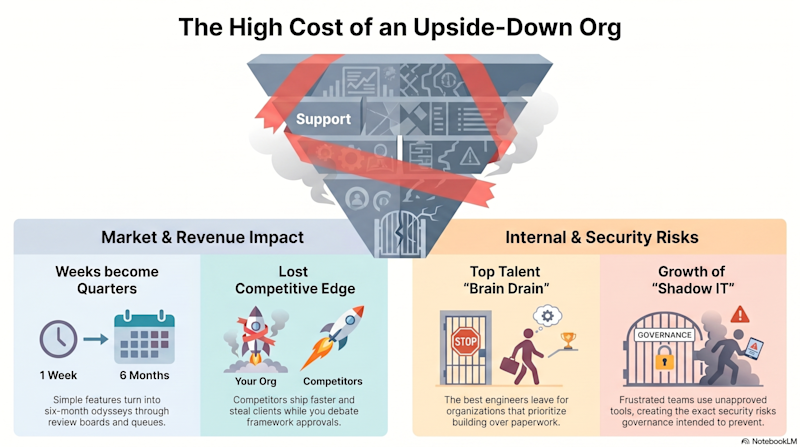
Features that should take weeks take quarters (or years). A two-sprint feature becomes a six-month odyssey through EA review boards, PMO planning cycles, QA regression queues, security assessments, SDLC governance checklists, and infrastructure provisioning queues.
Your best engineers & product people leave. Top talent doesn’t stick around to fill out PMO status reports, wait for QA sign-off on features they already tested, submit Change Requests, Access Control tickets and SDLC compliance forms. They go somewhere that lets them build things.
Competitors eat your lunch. While your Enterprise Architecture board debates whether to approve your new framework, Cyber has rejected your Access Control tickets for the third time, QA is still running last sprint’s regression suite, and the PMO is asking for an updated project plan, your competitor shipped three features and stole your biggest client.
“Shadow IT” thrives. When the official process is too slow—when the PMO timeline says Q3 but the business needed it yesterday—teams go rogue. They spin up unauthorized cloud accounts, skip the QA queue, use unapproved tools, and create the exact security and quality risks the governance layer was supposed to prevent. Ironic, isn’t it?
How to Flip Your Pyramid Back
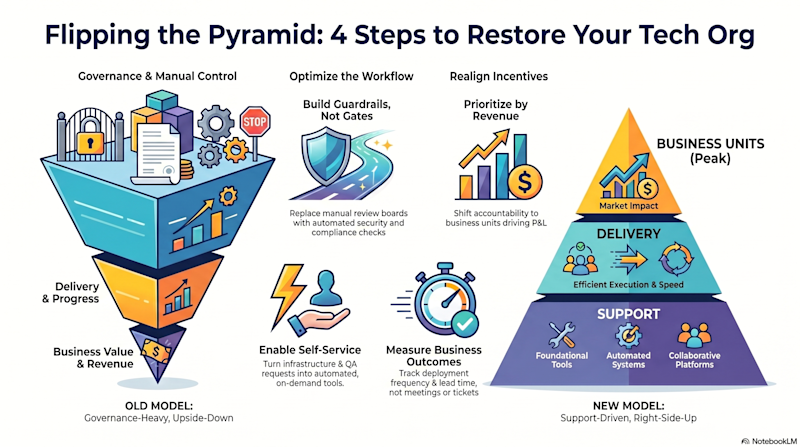
The good news: this isn't a permanent condition. You can flip your pyramid right-side up without burning the place down. Here's how:
1. Make support teams serve delivery teams, not control them. Security, QA, infrastructure, the PMO, Enterprise Architecture, and Reporting should all be building automated guardrails—not manual gates. If a security check requires a human to review a spreadsheet, automate it. If the PMO’s value is a weekly status meeting, replace it with a real-time dashboard. If Enterprise Architecture’s contribution is a review board that meets biweekly, turn those standards into reusable templates and self-service patterns.
2. Measure what matters. Track deployment frequency, lead time, and time-to-value—not the number of PMO status meetings held, SDLC artifacts produced, or change requests processed. If your Reporting team’s dashboards don’t connect to business outcomes, they’re vanity metrics. The PMO should measure delivery velocity, not slideware output.
3. Push accountability to where the revenue lives. Business units should have the loudest voice in prioritization. If the Enterprise Architecture team can veto a product decision with no business justification, or the PMO can delay a launch to align with an arbitrary reporting cycle, your pyramid is upside down.
4. Embrace "guardrails, not gates." The goal isn't to remove controls—it's to make them automated, fast, and invisible to the delivery team. Policy-as-code, automated compliance checks, and self-service infrastructure are how modern organizations stay safe without slowing down.
The Bottom Line
Your technology organization exists for one reason: to help the business win. Every layer, every team, every process should be oriented toward that goal. When your support functions exist to enable delivery, you get a stable pyramid that ships value fast. When they exist to control delivery, you get an inverted pyramid that's one bad quarter away from toppling over.
Look at your org chart. Look at who has veto power over shipping. Look at how long it takes to get a feature from idea to production.
If your pyramid is upside down, it's time to flip it—before gravity does it for you.
Back to Blog