
I need to admit something before we start, because it is going to be obvious within two paragraphs and I would rather say it than have you notice it.
I am not the man you want writing this essay.
I have spent two full series and four parts of this one arguing that feelings are not a system. That intention is not a control. That the way you fix an organization is with structure, written down, checkable, boring. I have been rude about engagement surveys. I once described a values poster as "a confession framed in the lobby." My whole professional personality is a man in a hard hat asking where the documentation is.
And I am about to tell you that the most important thing in this entire series is whether the people leading your teams actually care about them.
Bear with me. It reconciles.
A guide is not a person with a map. The map is a document; anybody can carry one. A guide is a person whose job is your progress instead of their own summit photograph, and the difference is not a skill. It is a decision they make repeatedly.
An organization can do everything right and still be cold
Let me describe a failure I have watched more than once, because it is the reason this part exists.
An organization builds the whole apparatus. Scorecards, honest and specific. A knowledge map, maintained. Behavior levels with acceptance criteria, written down, visible to everybody. By the standards of the last three essays, exemplary. I would have written them a commendation.
And people still leave. Quietly, steadily, the good ones first, in that pattern you learn to recognize with a sinking feeling.
Because the apparatus was administered rather than used. The levels arrived as a scorecard in an inbox once a quarter. The map existed and nobody walked it with anybody. Every system built to describe a person's growth was operated on them from a distance, by people who had never once given them the impression that their growth mattered to anyone but themselves.
You can hand somebody a perfect map and a compass and a full description of the terrain, and if you do it from the trailhead while checking your watch, they will understand exactly what you have communicated. Which is: the route is your problem.
So here is the reconciliation, and it is the whole point of the series. Structure without care is administration. Care without structure is sentiment. Neither one gets anybody up a mountain. The systems in Parts 2 through 4 are not a substitute for a leader who gives a shit. They are what makes a leader who gives a shit effective at scale, and what stops that care from being an accident of who your manager happens to be.
The give a shit factor
I did not invent the phrase and I would not have dared. It comes from a piece written by a college athlete and her father, and it names something that leadership literature has spent fifty years describing in language nobody quotes at a bar. They called it the give a shit factor. That is a better name than anything in my library, so I am using it.
It rests on three principles. I am going to state them plainly and then argue for each one from the least sentimental angle I can find, because that is the only way I know how to talk about this without embarrassing us both.
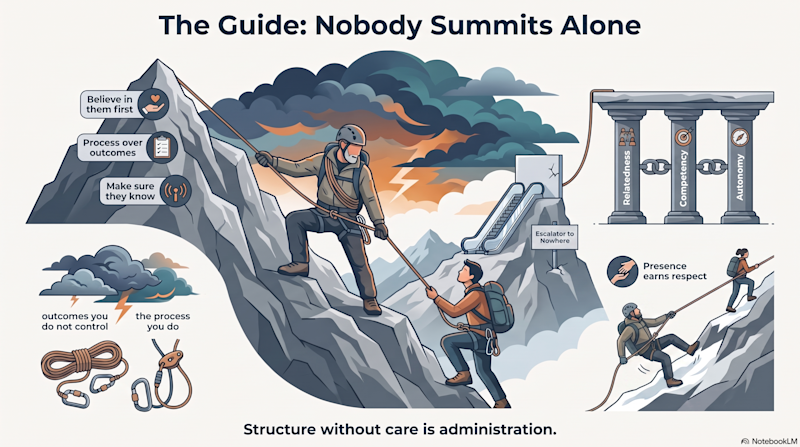
One: believe in your people, and put them ahead of yourself. Genuine faith in what they can become, and a commitment to their success that outranks your own accolades. The unsentimental version: a leader optimizing for personal credit and a leader optimizing for team capability make measurably different decisions about who gets the visible work, and one of those two builds an organization that is stronger in three years.
Two: focus on the process, not just the outcomes. Here is the line from that piece that I have not been able to put down: outcomes are not always in your control, but the process is. You can run a perfect quarter and lose the client. You can lead with total integrity and watch a project fail on a dependency you never touched. Sometimes the ball just rolls the wrong way. Judging your people primarily on outcomes means judging them substantially on luck, and everybody knows it, and it corrodes exactly the trust you need when the weather turns.
Three: make sure they know they come first. Not feel it. Know it. Communicate priorities so clearly and so consistently that nobody has to guess where they stand with you. This one is the most commonly failed, and it fails in the most frustrating way: leaders who genuinely do care, deeply, and have simply never said so out loud in a form anyone could detect. Care that is not transmitted did not happen. This is the part where a curmudgeon has to concede that saying the thing is part of the job.
Why it works, for the theory inclined
If you would like this without the profanity, the psychologists got here first, and their version is worth knowing because it explains the mechanism rather than just asserting the result.
Self Determination Theory says intrinsic motivation stands on three needs. Relatedness, the need to belong and be connected. Competency, the need to feel effective and capable. Autonomy, the need to have real control over your own actions. Meet all three and people do not merely perform better. They engage more deeply, stay longer, and find more meaning in the work.
Now look back at what we have built in this series, because the fit is almost suspiciously neat.
Part 2 built relatedness. Choosing the party deliberately, for the route, means the rope team is composed of people who can actually succeed together. Belonging is not a vibe you generate with an offsite. It starts with whether the person was set up to fit in the first place.
Parts 3 and 4 built competency. The map tells a person what there is to know. The markers tell them where they stand and what the next rung is. Feeling capable is not self esteem work, it is the direct product of knowing what good is and being able to see yourself getting closer to it.
And Parts 3 and 4 together built autonomy, which is the one people miss. When the terrain and the standards are written down and visible, a person can navigate on their own. They do not need permission or a favor or a quiet word from a sponsor. That is what autonomy actually is in a working organization: the ability to steer your own climb without depending on somebody else's goodwill for the map.
Which leaves exactly one thing the structure cannot supply, and it is the reason for this essay. The systems create the conditions. Only a person can supply the belief.
What guiding actually looks like on a Tuesday
Since I have spent four essays demanding specifics, it would be poor form to get vague now.
Guides have been higher, and are not climbing. The role is not to be the strongest climber. It is to know the route and to be looking backward down the rope while you look forward up it. A team lead who is still primarily optimizing for their own visible output has not started guiding yet, whatever the title says.
Guides give the route away. The instinct to hold the interesting work is the single most common failure of newly promoted technical leaders, and it is not selfishness, it is comfort. You are good at the thing. Handing it to somebody who will do it worse, this quarter, is how they become somebody who does it well next year. That is the whole trade, and it costs you something real every time.
Guides name where somebody is, out loud, regularly. Not annually. The markers from Part 4 are only useful if somebody actually reads them with the climber and says: here is where you are, here is the next rung, here is what I saw you do last week that counts. An assessment framework that is discussed twice a year is a document. Discussed monthly, it is a relationship with evidence in it.
Guides own the weather without pretending to control it. Projects fail. Clients change their minds. Reorganizations happen to good teams. The guide's job is not to promise the summit. It is to keep the party moving well through conditions nobody chose, and to make clear that when things go badly, the standard being applied is the process, which the team controls, and not the outcome, which it does not.
Guides are present, not perfect. This is the one that lets the rest of us off a hook we did not deserve to be on. You will not always say the right thing. You will go quiet in a moment that needed a voice, misjudge the tone, miss the sign that somebody was struggling. That does not disqualify you. What earns respect is showing up consistently, owning it when you miss, and choosing to try again. Not perfection. Presence.
And the return on all of this, which I mention last because leading with it would be crass: care is contagious. When a team can feel that the person leading them genuinely gives a shit about them and not only their output, they start extending the same thing to each other. They give each other grace when the words land badly, because they trust the intent underneath. But somebody has to set the tone first, and it is not going to be the org chart.
The question your people can already answer
I will close this one differently, because the usual self diagnosis does not work here. You cannot assess your own care. Everybody grades themselves generously on this and always has.
So ask a different question, and answer it honestly on their behalf.
If I asked the people who report to you whether you give a shit about them, would they hesitate?
Not whether they like you. Not whether you are good at your job. Whether they would have to think about it. Because the ones who have a guide answer that question immediately, and the ones who do not answer it carefully, and you have heard the difference between those two answers your entire working life.
Hesitation is the finding. And it is not a character verdict, it is usually a symptom of a leader carrying so much load that the transmission of care was the first thing to fall off the truck. That is structural, and structural things can be fixed.
GSD's Maturity Assessment looks at the People dimension in exactly these terms, at behavior rather than intention, at how teams actually work rather than how the handbook says they should. Find the gaps first, then close them.
Next week we stop diagnosing. Six essays of me telling you what is wrong is about four more than anyone should have to tolerate, so the finale is the playbook: what to do, in what order, starting Monday.
Nobody summits alone.
Next in the series, Part 6: "Base Camp Monday: A Climber's Playbook for Building Careers."
*Would your people hesitate? GSD's Maturity Assessment is the entry point, a structured look at where your delivery organization really stands, people included, before you invest in closing the gaps.*
Back to Blog