
We have spent five essays on the route. We met an engineer standing at the bottom of a mountain being told that the way up is to go up. We chose a party against a scorecard instead of a résumé, drew a map of what the organization actually knows, borrowed a language from educators so that "better" could mean something, and then admitted that all of it is administration unless somebody is actually guiding.
Diagnosis is the easy part. I have made a career out of it and I recognize the limits of the genre. The harder and more useful thing is telling you what to do on Monday. So here it is, without any metaphors I have not already worn through: the order of operations.
The best time to build a real route was before your best people started looking for one. The second best time is Monday morning.
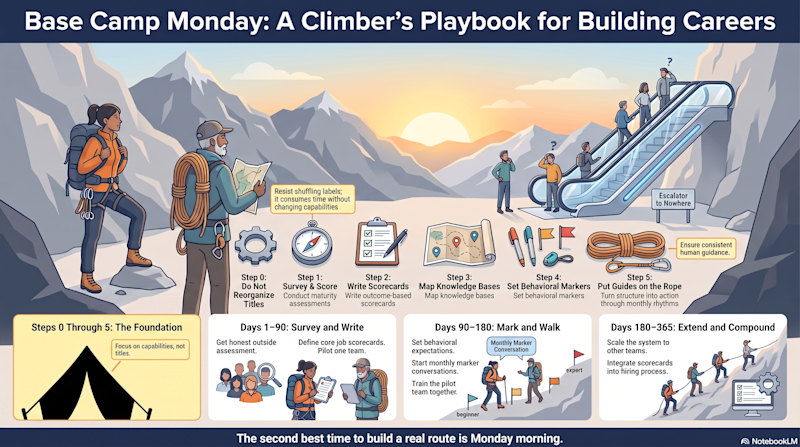
The steps, in the only order that works
Step 0. Do not reorganize the titles.
I know. It is the most available lever, the one that requires no new capability, and there is a slide deck in your organization right now proposing a cleaner ladder with better names. Resist it. A new title taxonomy laid over an organization that still cannot say what any job requires is a fresh coat of paint on the escalator. It will consume a quarter, produce a rollout, and change nothing about what any human being can do. Step 0 is not a delay. It is the discipline that makes every later step worth taking.
Step 1. Find out where you actually stand.
You cannot build a route across terrain you have not surveyed, and you cannot survey your own organization honestly. Everybody grades their own shop generously. Get an outside read on the real gaps. Are roles defined, or only titled? Does the knowledge live in a structure or in a person? Can anyone describe the next level in verbs? Would your people hesitate before answering whether their leader gives a shit? This is what GSD's Maturity Assessment is for, including a People dimension that looks at team structure and role behaviors as they actually operate, before you spend a fortune fixing the wrong thing.
Step 2. Write scorecards for the jobs you already have.
Not the jobs you are hiring for. The ones sitting at desks right now. For each core job, write the mission in a sentence or two, then four to six measurable outcomes, then the competencies required to hit them. This is the cheapest high value work in the entire playbook, it takes a few focused hours per role, and it will start arguments. Let it. Every argument it starts is one your organization has been silently having for years without the benefit of words.
Step 3. Draw the map.
Name the six to ten Knowledge Bases your organization actually runs on. Break each into Knowledge Areas, then into Topics. Then lay out each base as a matrix and describe what maturity looks like across it. Yes, it is tedious. Yes, it takes hours from your most experienced people, which is exactly why it never happens. It converts folklore into inventory, and inventory is the only form of knowledge that survives a resignation.
Step 4. Set the markers.
Take the map and convert it per job: for each Knowledge Area and Topic, what level of behavior does this job require? Then, for the core concepts, write acceptance criteria describing what a person must be able to do at each level. Use verbs. Recall, explain, apply, analyze, evaluate, create. When you are done, the question from Part 1 finally has an answer, in writing, that a person can hold in their hands and act on.
Step 5. Put guides on the rope, and make the caring visible.
Now, with the structure in place, do the part the structure cannot do. Make walking the markers with each person a monthly rhythm rather than an annual event. Judge the process, which your people control, ahead of the outcomes, which they do not. Give away the interesting work on purpose. And say the quiet part out loud, repeatedly, until nobody on your team has to guess where they stand with you.
Notice the shape of that sequence. The org chart never appears. Titles appear at Step 0 only so I can tell you not to touch them. That is not an oversight and it is not me being contrary. It is the entire argument of this series compressed into an order: capability first, structure second, labels last or never.
The roadmap: a year, honestly
Steps are nice. Calendars are better, because "we will get to it" is where structural work goes to die.
Days 1 through 90. Survey and write. Get the honest assessment and resist the urge to argue with the results. Then write scorecards for your existing core jobs, and name your Knowledge Bases down to Areas, though not yet all the way to Topics. Pick one team as your pilot. Do not attempt this across the organization at once. You are proving a route, not announcing a program.
Days 90 through 180. Mark the route and walk it. On the pilot team, convert the map into behavior expectations per job and write acceptance criteria for the core concepts. Then, immediately, start using them: monthly conversations, marker by marker, with real evidence. Train the team together rather than sending individuals to courses, because the failures live in the seams between roles and the seams are what a rope team practices. Expect the first pass at the criteria to be wrong in places. Fix them as you go. A map corrected in use beats a perfect map produced in a conference room.
Days 180 through 365. Extend and compound. Take what the pilot learned to the next teams, carrying the structure with you. Fold the scorecards back into hiring so that new people arrive against the same standard the existing people are measured by, which closes the loop and is the moment the whole thing starts to feel like one system instead of four initiatives. Assign real ownership of the map, with real time attached, or it will rot in eighteen months and you will be back to Dave.
That last stretch is where this pays. An organization with a written route gets smarter every year, because every expedition adds to the map. An organization without one relearns the same terrain forever, with a new cohort, at full price.
What you will get wrong
Four failure modes, offered so you can recognize them early rather than discover them in month nine.
You will try to boil the ocean. Every knowledge base, every job, every team, in one glorious quarter. It will collapse under its own documentation. One team, one job family, all the way through, then extend.
You will let it become a points system. The moment levels are wired mechanically to compensation, people optimize the measurement instead of the capability, and you will have built a machine for producing flattering self assessments. Levels inform human decisions. They do not automate them.
You will build it and not use it. This is the most common ending, and the saddest. The artifacts get produced, presented, filed, and never opened again, because nobody made the monthly conversation somebody's actual job. A map nobody walks with anybody is just paper with contour lines on it.
You will assume the caring part takes care of itself. It does not. It is the one piece of this that cannot be delegated to a document, and it is the piece most likely to be quietly dropped by a leader who is already carrying too much.
The final dare
I will leave you the way I always do, with a question you already know the answer to and have been avoiding.
Go find the best person on your team. Not the loudest. The one you would genuinely struggle to replace. And ask yourself, honestly, whether they could describe their next eighteen months to you in specifics. Not aspirations. Specifics. What they are getting better at, how they will know, and who is walking it with them.
If they cannot, they are on an escalator, and they are smart enough to have noticed, and the eleven month clock I described in Part 1 may already be running.
Here is the part I actually want you to take away, though, after all this structure and all this grumbling.
None of this is exotic. There is no proprietary framework, no platform to buy, no transformation to announce. It is a written job, a written map, written expectations, and a leader who shows up. Four unglamorous things, all of which your organization is entirely capable of building, and none of which it will build this year unless somebody decides to.
Careers are not something that happens to people while they wait. They are terrain that gets walked, deliberately, with a map somebody bothered to draw and a party that knows where it is going. Your people are going to walk a long way over the next decade regardless. The only real question is whether any of that walking happens inside your organization.
Give them a route. Then walk part of it with them.
Nobody summits alone.
This concludes "The Long Walk." Parts 1 through 6: the Escalator, the Party, the Map, the Markers, the Guide, and the Playbook.
Gerhart S. Dunn
*Ready to find out whether your people have a real route? GSD's Maturity Assessment is the entry point, a structured look at where your delivery organization really stands, people included, and the fastest way to find the gaps before you invest in closing them.*
Back to Blog