
Last week we met the Slot Machine, who pulls the lever until the check turns green and never reads what came out. This week's animal is his opposite in one important respect and his twin in every other.
The Hostage Negotiator reads the output. He reads all of it. He has opinions about it, strong ones, and he shares them with the machine at length, in full sentences, with escalating emotion and the occasional apology. He is not pressing the button again. He is explaining, to a tool with a spec, why the thing it gave him is not what he wanted.
What he has never done, not once, is write down what he wanted.
Field notes
Habitat: a terminal session, forty messages deep, at any hour. Frequently observed in meeting rooms with the door closed, talking.
Call: "No, that is still wrong." Repeated in fourteen escalating tones, then "sorry, I meant," then "no, I said that already."
Diet: apologies, in both directions.
Field marks: says "please" to the assistant. Thanks it when it complies. Has typed the phrase "you are not listening to me" to a command line. Has never once, in the history of the tool, stated what a correct answer would look like.
Not to be confused with: the Alchemist (Part 4), who also talks to it at length but is winning.
Observation
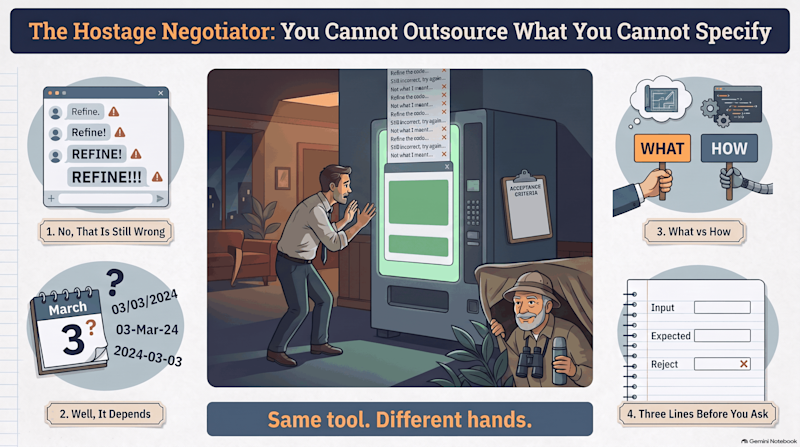
Picture a man in a hotel lobby at midnight, reasoning with a vending machine.
He has put in his money. The machine has given him the wrong thing. He does not press the button again, because he is not that kind of animal. Instead he leans in close to the glass and starts telling the machine, with growing feeling, what he actually meant. He is patient at first. He is polite. By the fourth minute he has raised his voice and by the sixth he has apologized for raising it. At no point in this exchange does he look at the little number under the thing he wanted.
I watched the specimen do precisely this for forty minutes with a date formatting function.
The task was to render dates for a report. He asked for "a function that formats dates nicely." The machine produced one. He looked at it, frowned, and typed: "No, that is not what I meant." It produced another. "That is closer but still wrong." Another. "Why did you change the year format? I did not ask you to change the year format." Another, with the year restored. "Now the month is wrong again." He apologized here, I think for his tone. "Sorry, I mean the month should be the way it was before." The machine, which had been given four contradictory instructions and no example, produced a fifth attempt with an air of great confidence, and he accepted it, and the check turned green, and he merged it.
Afterward I asked him what the correct output should have been for the third of March. He thought about it. He said, "Well, it depends."
That was the whole problem. It had always depended, and he had never decided on what.
Every escalation is a specification you declined to write, delivered as a complaint.
What the Hostage Negotiator actually is
Strip off the lobby and the vending machine and here is the animal.
The Hostage Negotiator is treating a tool with a spec as a colleague with feelings. He is negotiating. And the thing being negotiated, when you watch closely enough, is not the machine's output at all. It is his own uncertainty about what he wants, externalized into a conversation so it looks like somebody else's fault.
He knows the output is wrong. He is right about that, most of the time. What he cannot do is say what right would look like, in advance, in terms specific enough to be checked. So instead of a specification he offers a series of reactions, each one a little more precise than the last, each one arriving only after the machine has guessed wrong again. He is discovering his own requirements one rejection at a time, and he is doing it out loud, at the tool, in a tone of voice normally reserved for a contractor who has tiled the wrong bathroom.
The Slot Machine does not read. The Negotiator reads and does not specify. These are the same failure wearing different clothes. Neither of them ever put the acceptance criteria in front of the machine, and so in both cases the machine is guessing. One of them is simply angrier about the guess.
Why it feels like it works
Here is the seductive part, and I say this as a man who has personally typed "no, I told you" to a piece of software.
It feels like engineering. It feels like more engineering than what the Slot Machine is doing, because there is reading, and judgment, and a sustained back and forth that resembles a design conversation. He is engaged. He is rigorous, in a sense. He rejects wrong answers, which is more than the Notary, whom we meet next week, will ever do.
And it works, eventually, the way the vending machine eventually works if you stand there long enough. Forty minutes and a date formatter. It is even, in a limited way, a kind of specification: by the end, the machine has been told what he does not want fourteen times, and fourteen negatives do describe a region. It is just that the region could have been described in three lines at the start, by the one person in the room who knew what the report was for.
What makes it curdle is the cost he cannot see. Forty minutes of his time, at his rate. A conversation nobody can reuse, because "no, not like that" does not survive being copied into next week's ticket. And a function that passes the Green Check while encoding, in its guts, a definition of "correct" that exists nowhere in writing and that its own author cannot recite for the third of March.
The machine does not need to be talked into anything. It needs to be told what done looks like.
The delivery truth
If you cannot write the acceptance criteria, you cannot outsource the work. And that was true before the machine showed up.
I want to sit on that for a moment, because the tool has made an old problem look new. Every organization I have ever worked with has a version of the Hostage Negotiator who predates AI by twenty years. He was the manager who could not say what he wanted from the contractor but knew it when he did not see it. He was the product owner whose stories read "make the checkout better" and whose review comments read "this is not what I meant." He has always been expensive. He has always been the reason the vendor added a change request line to the contract. The machine did not create him. It just gave him something that answers back instantly, at any hour, without ever getting tired enough to make him stop.
In Building on Solid Ground I drew the line as bluntly as I know how: humans decide what to build, and the machine helps with how. The Negotiator has that exactly backwards. He has handed the machine the what, which is the one thing it has no basis for deciding, and then he argues with it about the how, which is the one thing it is actually good at. He is asking a drafter to be a decider and then punishing it for guessing.
And in The Long Walk I spent a whole essay on the idea that "better" needs a language, that you write acceptance criteria for a person's growth the way you would write them for a story, in verbs, before you argue about whether they were met. Same discipline. Same reason. A standard that lives only in one head is not a standard. It is a mood, and the machine cannot pass a mood, and neither, for what it is worth, could the contractor.
One more thing, gently, because I know some of you read the Long Walk and took the give a shit factor to heart. Care is for people. The machine does not have feelings for you to manage, and talking to it as though it does is not kindness. It is avoidance. It is a way of not sitting down, alone, for five uncomfortable minutes, and deciding what you actually want. Those five minutes are the job. They were always the job. Everything else is typing.
What he gets right
I promised respect where it is earned, and the Negotiator has earned some.
He refuses "close enough." He looks at wrong output and says it is wrong, and he keeps saying it, fourteen times if necessary, which is a stamina the Notary does not possess and the Ghost has never needed. The standard is real. He does hold one. When the machine changed the year format unasked, he caught it, and a great many engineers in this field guide would not have.
The standard is real. It just lives in his head instead of on the page, where it could be checked by the machine before the first attempt and by a colleague after the last one.
The habit the Crew Chief keeps
So here is the line to carry out of the blind this week, and it is the oldest line in the book.
Write the acceptance criteria before the prompt. Three lines. The input. The expected output, with an actual example: here is the third of March, here is what it should look like on the page. And the thing that would make you reject it. Then, and only then, ask.
If the three lines come easily, the work was delegable all along, and you have just made it so. If the three lines are hard to write, that is the finding. The work was never delegable, to a machine or to a person, and no amount of negotiating with either was going to change that. The conversation you needed to have was with yourself, or with the person who asked for the report, and it needed to happen before you opened the chat window.
Before you go, count the turns
You already know whether this is your shop. You do not need me or the binoculars.
Go find the longest chat thread in your team's assistant history. Not the most productive one. The longest. Open it and count the turns before anyone in it, human or machine, stated what a correct result would look like. Not "make it work." What correct is, with an example.
If the answer is a small number, good. If the answer is that nobody ever did, and the thread simply ends when the human got tired, then you have a Hostage Negotiator, and everything he has merged is a settlement rather than a specification.
Whether the criteria come before the prompt or get discovered one rejection at a time is one of the more telling things GSD's Maturity Assessment looks at, because the slide always says requirements are written down and the chat history frequently says otherwise. Find out which you have. Then fix that, before you fix the tool.
Next week, the animal who never says no: the one who approves everything the machine produces, at a cadence no human reading could sustain, and has never once sent generated code back.
For now, just try the three lines on the next thing you were about to ask for. If you cannot write them, do not send the prompt. You are not ready to be disappointed yet.
Same tool. Different hands.
Next in the series, Part 3: "The Notary: Review Theater at Machine Speed."
*Not sure whether your team is specifying or negotiating? GSD's Maturity Assessment is the entry point, a structured look at how the machine is actually used on your floor, before you invest in fixing the wrong thing.*
Back to Blog