
I want to be careful with this one, because I like him.
Four posts into a field guide built mostly on observational cruelty, it is time to admit that one of the species is the one the rest of us secretly admire. He is the engineer the Slot Machine wishes he were, and the one the Ghost's teammates go looking for at two in the morning. If I could pick one person in the building to have a beer with, it is him. If I could pick one person to hand the tool to, it is also him, and he will not take it.
That is the whole tragedy, and it is a small one, and it is the most fixable thing in this series.
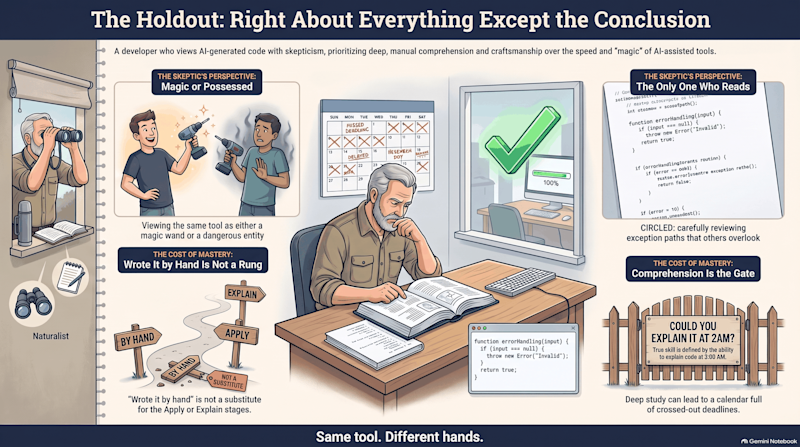
Field notes
Habitat: a clean editor with no assistant pane, a mechanical keyboard, a strong and settled opinion about tabs.
Call: "I would rather understand it." Delivered quietly, without heat, in a way that ends the conversation.
Diet: documentation, read in full, from the beginning, including the changelog.
Field marks: the smallest pull requests on the team and the fewest reverts. Also the slowest cycle time and the most missed delivery commitments.
Not to be confused with: the Alchemist (Part 4), who agrees with him about everything except the tool.
Observation
The specimen was given the same task as the one I described in Part 1: add a retry policy to a payment call. I was curious, so I watched.
He read the existing call. He read the client library's retry documentation, all of it, including a footnote about idempotency keys that turned out to matter. He wrote about thirty lines, with a bounded backoff and a test that asserted the timeout still surfaced after the final attempt. He wrote a commit message explaining the footnote. He opened a pull request that could be reviewed in four minutes by anyone who bothered.
It took him most of a day.
That same day, two desks over, the Slot Machine merged four things, one of them the retry policy from Part 1 with the swallowed exception and the deleted test. The check was green on all four. At the demo for that cycle's delivery commitment, the Holdout's one item was the only one that worked as described. Nobody noticed, because nobody demos the exception path.
He does not trust the Green Check. He is the only one of the six who does not. He is right not to. And it is not saving him.
He is the best engineer in the field guide, and he is losing to people who are worse than him at everything except finishing.
What the Holdout actually is
Strip off the sympathy for a moment and here is the animal.
The Holdout refuses the tool on principle. Not on ignorance, because he has read more about the machine than anyone who uses it. He refuses because he has watched what the tool does in other hands and concluded that the tool is the problem. He hand crafts everything. He can explain every line he has ever merged, under oath, from memory. He is morally correct about craft, about comprehension, about the Slot Machine and the Notary and the Ghost, and about the fact that a green check is a claim and not a proof.
And he is losing. Not an argument. He wins those. He is losing the delivery commitments, cycle after cycle, to teammates who would not pass his review and do not have to, because his review is not in their path and his output is a fraction of theirs.
Why it feels like integrity
Every species in this guide is locally rational. The others feel like they are winning. The Holdout does not feel like he is winning. He feels like he is right, which is more durable and much harder to argue with.
Abstention feels like a standard. It has the shape of one. It says: I will not ship what I do not understand, and since I cannot understand what the machine produces as well as what I wrote, I will not use the machine. Each clause is defensible. The conclusion is where it goes wrong, and it goes wrong quietly, because nobody ever has to defend it. It is the position that never gets a code review.
The delivery truth
Earlier this summer I opened Know Thy Machine with a line I still think is the most useful thing I have written about this subject. There are two ways to be wrong about a power tool. The first is to think it is magic: wave it at the wood and trust that furniture will emerge. The second is to think it is possessed: refuse to go near it, whisper about it in meetings, and forbid anyone from touching it until the risks are understood. Both people end up with no furniture. One because the table collapsed, the other because the table was never built.
The Slot Machine thinks it is magic. The Holdout thinks it is possessed. And the cruelty of it, the thing that made me put down the binoculars for a minute, is that of all six species he is the one who would use it best. He is the only one who would read what it produced. He is the only one who would find the swallowed exception on the first pass, because he is the only one who reads exception paths on principle.
The machine does not need a person who trusts it. It needs a person who does not, and who reads. That is him. He has taken the single most valuable habit on the floor and applied it to nothing.
Abstention is not a standard. Comprehension is a standard, and it can be applied to generated code exactly as well as to typed code, by exactly the people who insist on it.
Two other things, briefly, because he will raise them and he deserves an answer.
He will say the tool is not free, and he is right. I wrote a whole essay on the three faces of cost, and the third face, the human review the machine creates, is real and routinely uncounted. But his alternative is not free either. A day spent on thirty lines is a real number his organization is paying whether or not anyone writes it down. The honest comparison is not machine versus nothing. It is machine plus his reading versus his typing, and for much of the work on his desk the first one produces the same thirty lines, read by the same person, to the same standard, before lunch.
And he will say that writing it by hand is how he understands it. Here I want to borrow from The Long Walk, where we spent a whole post building a language for what "better" means, out of behaviors. Recall. Explain. Apply. Analyze. Evaluate. Create. Those are the markers. Look at them for a moment and notice what is not there. "Wrote it by hand" is not a behavior on any rung. It is a method, and it is one method among several for reaching the rung that is actually on the marker, which is explain. He has confused the route he took up the mountain with the altitude. The altitude is the standard. The route is negotiable.
What he gets right
Most of it. I mean that, and I want to spend the rest of this post on it, because the previous four posts were about what the specimen gets wrong and this one is about what the shop gets wrong about him.
He will not ship what he does not understand. That is the gate. That is the entire argument of this series, compressed into one sentence, and he arrived at it years before the machine showed up. The Slot Machine does not have it. The Notary does not have it. The Ghost, whom we meet next week, will find out at two in the morning that he does not have it. The Holdout has it, and holds it, and holds it so hard that he has decided nothing can pass through it that he did not make himself.
He reads exception paths. He reads the changelog. He writes the test that asserts the failure still fails. His pull requests are small because he knows what a reviewer can actually hold in their head, and his reverts are rare because he has already imagined the two in the morning before he merges. Every one of those is a habit the Crew Chief keeps, and every one applies to a generated change exactly as well as a typed one. Better, honestly, because a generated change needs them more.
And he has been watching. That is the part the shop misses. His refusal did not come from nowhere. He sat two desks from the Slot Machine and watched the lever get pulled. He reviewed, once, a change the Notary had already approved, and found the deleted test, and said so, and was told it was already merged. He has read the Ghost's code during an incident. His objection was never really to the tool. It was to what he has watched the tool do in hands that do not read, and he generalized the hands to the tool because the hands were the only version of the tool he had ever seen.
The Holdout is not wrong about the machine. He is wrong about who is allowed to hold it.
His shop, meanwhile, has made him the cautionary tale. The slow one. In the metric that counts merged items he is last on the team, and in the metric nobody keeps, changes that survived production without a revert, he is first by a distance. He is being managed against the wrong number and he knows it, which is one more reason to believe the tool is the enemy, because the tool is what the number rewards.
If you run a team and you have one of these, understand what you have. You have the person who could teach the other five to read. You have the reviewer whose no would mean something. You have the standard, walking around, unused.
The habit the Crew Chief keeps
Here is the one line to carry out of the blind.
Comprehension is the gate, not abstention. Use the machine, then hold its output to the exact standard you hold your own: could you explain it, line by line, to someone who is angry at two in the morning? If yes, merge it, and it does not matter who typed it. If no, it is not done, however green the check is, and it does not matter who typed that either.
He already has the second half of that sentence. He only needs the first.
Before you go, ask him one question
You know whether you have one. Every shop has one. He is easy to spot, because he is the person whose pull requests you would actually let your own money ride on.
Go find him. Do not bring a slide. Ask him one question, and listen to the whole answer: is your objection to the tool, or to what you have watched the Slot Machine do with it?
It is almost always the second. And the second is a conversation you can have, because it is a conversation about standards, and he has better ones than you do. Ask him what a generated change would have to look like for him to merge it. Write down what he says. You now have acceptance criteria for AI-generated code, authored by the one person who was ever going to enforce them.
Whether your shop has turned its best reader into its slowest contributor, and whether the standard he carries is written down anywhere other than in his head, is one of the things GSD's Maturity Assessment goes looking for. Not the tool adoption number. The reading. The slide always says comprehension is a merge criterion, and the floor frequently disagrees.
For now, go have the beer. He has earned it, and he is going to be very good at this once he lets himself pick it up.
Same tool. Different hands.
Next in the series, Part 6: "The Ghost: You Cannot Be On Call for Code You Never Read."
*Is your most careful engineer your slowest one, and is the standard he carries written down anywhere? GSD's Maturity Assessment is the entry point, a structured look at how the machine is actually used on your floor, before you invest in fixing the wrong thing.*
Back to Blog