
I actually believe that we can be all six animals, depending on the day.
That is the honest answer, and it is the reason this finale exists. Nobody is one animal. Everybody is a mode, and the mode changes with the deadline and the hour. So the last post in the field guide is not a seventh species. It is what you get when you take one habit from each of the six and leave the rest in the blind.
Six animals, one afternoon
We have spent six essays in a canvas chair. We watched the Slot Machine pull the lever until the Green Check lit up, then read the diff he did not. We watched the Hostage Negotiator plead with a tool that has a spec and no feelings. We timed the Notary at seventy-four seconds per approval. We met the Alchemist, who is Dave with a second map, and the Holdout, who is right about everything except his conclusion. And we sat in a dark room at two in the morning with code the Ghost could not explain under oath.
Diagnosis is the easy part. The harder, more useful thing is telling you what to do on Monday. So here it is: the order of operations.
The best time to teach your people to read what the machine writes was before you rolled it out. The second best time is Monday morning.
The signature under the cockpit
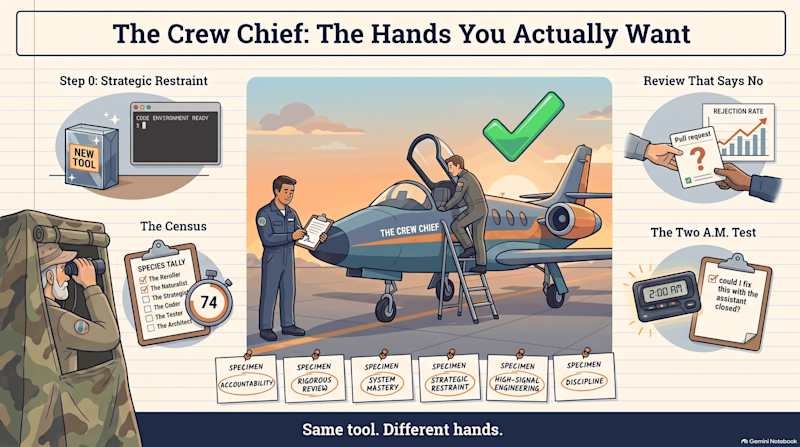
On a flight line, the pilot flies the aircraft. The pilot gets the callsign, the patch, and the photograph. But look under the cockpit and you will find a second name stenciled on the fuselage, and it is not the pilot's. It belongs to the crew chief, who does not fly, and who owns whether the thing is fit to fly. Before every sortie the crew chief signs a form that says so, and that signature follows the aircraft for the rest of its life.
That signature is the whole series. In Building on Solid Ground I said nothing advances on a robot's say-so, that there is a human signature between every phase and the next, and that the signature is the point. Every species in this guide is a way of standing at that gate without signing. The Slot Machine lets the exit code sign. The Notary signs without reading. The Ghost signs and forgets. The Holdout never lets anything reach the gate. The Crew Chief signs, means it, and could defend it at two in the morning.
The six habits, in one place
Each species got one thing right, and I promised the finale would be built from those six lines. Here they are, verbatim, so you can put them on a wall.
Read before you re-pull. The Slot Machine.
Write the acceptance criteria before the prompt. The Hostage Negotiator.
Review that can send things back. The Notary.
Context is the craft, and craft belongs in the shared record. The Alchemist.
Comprehension is the gate, not abstention. The Holdout.
Ship only what you could be on call for. The Ghost.
Not one of them is about the tool. Not one requires a new vendor, a new model, or a new line in the budget. They are all about what the hands do when the Green Check comes on.
The steps, in the only order that works
Step 0. Do not buy a different tool.
I know. The vendor has a new version, a competitor is bragging about theirs, and someone on your leadership team has a slide arguing that the problem is the model. It is not the model. It is the same tool on every desk in your building and in mine, and it produces six different animals in both. A new vendor is a new coat of paint on the same six species. Step 0 is not a delay. It is the discipline that keeps you from spending a quarter changing nothing about what any human does.
Step 1. Find out which species you have.
Not by asking. Everybody grades their own shop on a curve, and every one of the six will tell you they are the Crew Chief. Count instead. What is the rejection rate on generated changes? If it is zero, you have Notaries. Pick five generated changes in production and ask each author to walk you through one with the assistant pane closed; time how long it takes to reach the words "I think." That is your Ghost count. Find the person whose generated code is visibly better than everyone else's and ask whether anyone could reproduce it if they were out for a month. That is your Alchemist. This is precisely what GSD's Maturity Assessment does from the outside, which is the only place the census is honest, because nobody in the blind can see their own hands.
Step 2. Write acceptance criteria before prompts.
The Hostage Negotiator's fix, made a team norm. Three lines, before the first request, every time: what goes in, what should come out, and what would make you throw the result away. It takes ninety seconds. If the three lines are hard to write, the work was never delegable, to a machine or to a person, and you have just found that out before spending forty minutes arguing with a vending machine.
Step 3. Make review capable of no.
The Notary's fix. Put one number on the wall: the fraction of generated changes that came back with a question. Not approvals per day, which rewards the stamp. Rejections, which reward the reading. A review with a zero rejection rate is not a review, and the trail it produces is worse than none, because it carries a name and a timestamp on a claim that is false. If your customers include a bank, this is the step that decides whether your approval records are evidence or an alibi.
Step 4. Move the craft into the shared record.
The Alchemist's fix. The four thousand word master prompt goes in the repo, versioned, reviewed, with a name on it that is not only his. This is the rule Solid Ground gave for every other piece of organizational knowledge: distill it, store it with its origin attached, and put it where the organization can reach it instead of where one laptop can. You are not taking anything from him. You are making sure that when he takes a month off, the results do not go with him.
Step 5. Make comprehension the gate.
Now the part the structure cannot do on its own. Take the Holdout's standard, could you explain this line by line to someone who is angry at two in the morning, and apply it to everyone, for every merge, generated or typed. Take the Ghost's appetite to ship and size it to that standard: if the answer to the two a.m. question is no, the change is not done, however green it is. And take the Slot Machine's reflex, which is a good reflex, and add the one sentence of reading that turns rerolling into iteration. Comprehension is the gate. Abstention is a locked door. Volume is the door left open.
Notice the shape of that list. The tool appears at Step 0, and only so I can tell you not to touch it. Every step after that is about the hands, and every step is buildable with what you already own. The machine was never the variable.
The roadmap: a year, honestly
Steps are nice. Calendars are better, because "we will get to it" is where good habits go to die.
Days 1 through 90. Census and criteria. Get the honest read from outside and do not argue with it. Then, on one team, only one, make the three line acceptance criteria a norm before every prompt. Start counting the rejection rate on generated changes, even though the number will be embarrassing, because that is the point of counting it. You are proving a set of hands, not announcing a program.
Days 90 through 180. Review that says no, and a shared record. Put the rejection rate on the wall and watch it climb, which is the right direction for now. Move the master prompts into the repo with the Alchemist's name on the first pull request. Add the two a.m. question to the merge checklist as an actual checkbox. Expect friction. The Holdout will be delighted and the Ghost will be furious, and both reactions tell you it is working.
Days 180 through 365. Extend, and watch the number fall for the right reason. Carry the habits to the next teams. Somewhere in this stretch the pilot team's rejection rate starts to fall, and this time it is because the prompts got better and the criteria got sharper, not because the reviewers stopped reading. That is the moment you have a Crew Chief culture instead of a Crew Chief memo. It compounds from here, the way the Long Walk said everything worth building does: each cycle teaches the team something it keeps. Or it evaporates, and next year you meet the same six animals wearing new badges.
What you will get wrong
Four failure modes, so you can recognize them in month three rather than discover them in month nine.
You will ban the tool for a quarter. Somebody will read the Ghost post, get a chill, and propose a pause "until we have a policy." Congratulations, you have built a department of Holdouts, with the Holdout's output problem at scale and a memo attached.
You will measure volume. Lines generated, pull requests merged, hours saved. Every one of those numbers rewards the Slot Machine and the Ghost, and the dashboard will look magnificent right up to the incident. Measure the rejection rate and the two a.m. test. Nothing else is safe on a wall.
You will let the Alchemist stay a library with one card. Because he is producing the best work in the building and moving his craft into the shared record feels like slowing him down. It is not. It is the cheapest resilience in this playbook.
You will assume the reading happens. It does not. Every species in this guide is a way of not reading while appearing to, and the Green Check exists so that nobody has to. The reading has to be somebody's job, with a number attached, or it will quietly stop the first week a deadline gets close.
The final dare
I will leave you the way I always do, with a question you already know the answer to and have been avoiding.
Go stand behind the best AI coder on your team for an hour. Not the fastest. The best, the one whose generated code you would trust in the billing job. Watch the hands. Watch what they do when the first attempt comes back red, whether they scroll the diff or scroll past it.
Then go stand behind the fastest, and watch what they are looking at when the check turns green.
If it is the diff, you have a Crew Chief and you should pay them accordingly. If it is the check, you have one of the other six, and you have been shipping their signature on your fuselage.
None of this is exotic. There is no model to buy, no platform to adopt, no transformation to announce. It is six habits, each already practiced by somebody on your team, just never by the same person on the same day.
The tool is fine. It was always fine. It is the same tool on every desk, and every bit of the variance is in the hands.
Put your name under the cockpit. Then sign the form like you mean it.
Same tool. Different hands.
This concludes "Known Species." Parts 1 through 7: the Slot Machine, the Hostage Negotiator, the Notary, the Alchemist, the Holdout, the Ghost, and the Crew Chief.
Gerhart S. Dunn
*Ready to find out which species is holding the machine on your floor? GSD's Maturity Assessment is the entry point, a structured look at how the tool is actually used before you invest in fixing the wrong thing. And if you would rather hire the hands than grow them, the Crew Chief is what a GSD team looks like when you subscribe to one: a delivery commitment published before every cycle, demoed at the end, and signed by people who read what they ship.*
Back to Blog