
I once watched a company celebrate a project that came in "under budget." There was cake. There were congratulations. There was a slide with a green arrow.
Six months later somebody finally added up the maintenance, the rework, the two senior engineers permanently assigned to babysit the thing, and the cloud bill that had quietly tripled. The project had cost roughly double the original estimate. But the cake was long gone, and nobody connects the cake to the carnage. That's the trouble with cost. It arrives late, in a different room, addressed to someone else.
AI has supercharged this particular comedy. The tools are cheap to start and expensive to keep, the savings are loud and the costs are quiet, and almost nobody is doing the honest arithmetic.
"AI made us faster" is not a sentence. It's half of one. The other half has a dollar sign in it.
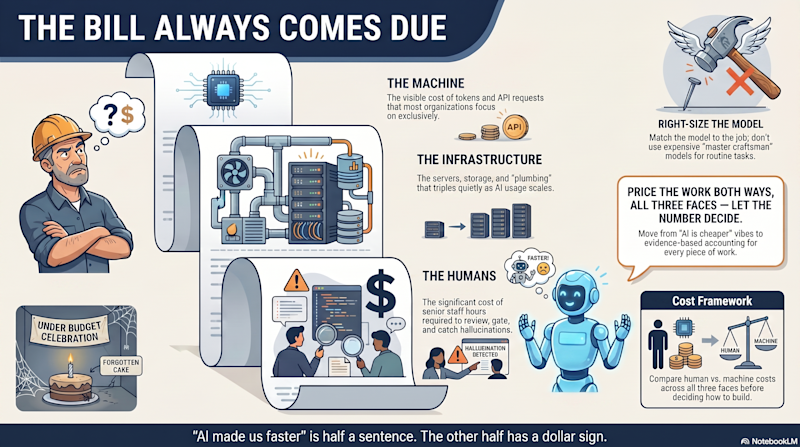
The most dangerous number in technology
Here's a sentence that has launched a thousand doomed initiatives: "It's basically free."
The machine feels free because each individual request costs a rounding error. A fraction of a cent here, a fraction there. So nobody watches the meter. But "a fraction of a cent, times a number you never bothered to count" is how you get a bill that makes your eyes water. Superman III anyone? Or Office Space? The danger of AI cost isn't that any one action is expensive. It's that every action is cheap enough to ignore and frequent enough to matter. That's not a small bill. That's a small bill with no one reading it, which is a large bill wearing a disguise.
The first discipline, then, isn't frugality. It's visibility. You cannot manage what you refuse to measure, and "it's basically free" is just a polite way of refusing to measure.
The bill has three faces
When organizations finally do the math, they make a second mistake: they count the obvious face and miss the other two. So let me lay all three on the table, because GSD insists on tracking every one of them.
Face one: the machine. What you pay for the AI to think. Tokens, requests, calls, whatever your vendor charges for. This is the one everybody eventually sees, because it shows up on an invoice with the word "AI" on it. It is usually the smallest of the three.
Face two: the infrastructure. The machine doesn't run in a vacuum. There's the place it runs, the place its memory lives, the systems that move the work around, the storage for everything it produces. This is the face that "triples quietly," because it grows with usage and nobody assigned it an owner. It's the plumbing bill on the build site, invisible until the basement floods.
Face three: (and this is the one that separates the pros from the optimists) the humans. Here's the part the vendors will never put on a slide. AI creates human work. Every draft the machine produces, a person has to review. Every gate, a person has to consider and sign. Every confident hallucination, a person has to catch before it ships. The Magic Intern doesn't reduce your senior people's load by replacing them, it changes their job from writing to checking, and checking is not free.
This is not an argument against AI. It's an argument for honesty. If you count only face one, AI looks like a miracle. Count all three, and it becomes what it actually is: a tool with a real, knowable cost and a real, knowable return, which is a far better thing to own than a miracle you can't explain.
The comparison nobody runs
Here's the question that should be on the wall of every delivery shop, and almost never is:
For this specific piece of work, what does the machine cost versus what the human costs, all three faces included?
Run that comparison honestly and you stop arguing about AI in the abstract. You start deciding, case by case. Some work is perfect for the machine: high volume, well-trodden, cheap to check. The intern crushes it and the math is obvious. Other work is judgment-heavy, novel, and expensive to verify, the kind where a confident wrong answer costs more to catch than a careful human answer cost to produce. There, the machine is the expensive option wearing the cheap costume.
You will never know which is which by feel. "AI is cheaper" and "AI is overhyped" are both religions. GSD treats it as accounting: price the work, both ways, all three faces, and let the number decide. Sometimes the answer is the robot. Sometimes it's the person. The point is that it's an answer, not a vibe.
Don't put the master craftsman on every nail
One more piece of arithmetic that saves real money, and follows straight from Part 3's crew of specialists.
There isn't one AI. There's a range, from enormous, powerful, expensive models that can reason through genuinely hard problems, down to humbler, faster, cheaper ones that are perfectly good at routine work. The expensive instinct is to use the most powerful model for everything, because it's the best, and why wouldn't you want the best?
Because the best is also the priciest, and most work doesn't need it. You don't fly in a master craftsman to hammer a single nail. You give the routine work to the humbler tool and save the expensive genius for the problems that actually require genius. Matching the model to the job, what we'd call right-sizing, is one of the highest-return decisions in the whole operation, and one of the least glamorous, which is why almost nobody does it until the bill forces them to.
Costing knowledge, not just code
Now the idea I find genuinely elegant, and it ties back to the bedrock.
Remember the shared record from Part 2, the one where every distilled claim lives with its origin attached? Because every piece of knowledge knows where it came from, you can do something most shops can't even imagine: you can price understanding itself. You can stand at a single decision and know what it cost to reach, the thinking, the drafts, the human review, all of it.
That sounds academic until the day a project overruns and someone asks "where did the money actually go?" In most shops, that's a séance. In a shop built on solid ground, it's a query. The cost of a thing is attached to the thing, all the way down. You don't reconstruct the spend from memory and guesswork. You read it.
A grubby little test
Here's how you find out where you really stand, and it takes about a day.
Pick last week. Can someone in your organization tell you what your AI spend actually bought, not the total on the invoice, but which work, at what return, against what it would've cost the human way? All three faces?
If the answer is a confident number, you're running a business. If the answer is "let me pull the invoice" followed by a long silence, you're not managing AI cost, you're receiving it, which is a very different and much more expensive posture. Whether cost is something your shop steers or something that simply arrives is one of the clearest signals GSD's Maturity Assessment picks up, because it shows up in behavior long before it shows up on a spreadsheet.
The bill always comes due. The only question is whether you saw it coming or whether, like the company with the cake, you find out in a different room, six months late, addressed to someone else.
Measure twice, prompt once.
Next in the series — Part 5: "The Inspector at the Door — Audit as a First-Class Citizen."
*Can your shop say what its AI actually bought last week? GSD's Maturity Assessment surfaces whether you steer your costs or simply receive them — before the bill arrives.*
Back to Blog